You picked up your phone to check one thing. Twenty minutes later, you’re deep in a comment section you don’t even care about, wondering how you got there.
It happens to almost everyone, and it happens multiple times a day. The real question isn’t whether you’re using your phone too much. It’s whether you actually know how much is too much, and what to do about it when the answer is yes.
This guide cuts through the vague advice and gives you a clear, honest framework: what the research actually says about healthy phone use, how to figure out your personal limit, and more importantly, the practical steps that make change stick. Not willpower tips. Structural ones.
Whether you’re at 3 hours a day or 8, this is worth reading with your Screen Time report open beside you.
Quick Takeaways
- Experts recommend keeping recreational phone use under 2-3 hours per day, yet the average American now spends over 5 hours daily on their phone alone.
- A 2025 randomized controlled trial found that reducing phone use to 2 hours per day for just 3 weeks significantly improved well-being, reduced depression symptoms, lowered stress, and improved sleep quality.
- There is no single “right” number. The better question is: does your phone leave you energized or drained?
- The quality of time matters as much as the quantity. Intentional use vs. mindless scrolling produces very different outcomes.
- Small, consistent friction points, not willpower, are what actually change the habit.
- Your phone’s built-in Screen Time (iOS) or Digital Wellbeing (Android) dashboard is the honest mirror most people avoid.
You probably already have a suspicion. You know the number is higher than it should be, and you know because you’ve felt it: the slight fog after an hour of scrolling, the mild guilt when you reach for your phone before you’ve even gotten out of bed, the way the evening disappears into a feed of content you can barely remember by morning.
So let’s be honest about where we are first.
Where Most People Actually Are (The Numbers Are Startling)
Americans spend an average of 5 hours and 16 minutes per day on their phones – a 14% jump from the previous year, according to a 2025 Harmony Healthcare IT survey of over 1,000 adults. If you’re Gen Z, that number climbs to over 6 hours and 27 minutes. Even Baby Boomers – the generation that grew up without smartphones – are averaging just over 4 hours daily.
That’s still more than double what health experts recommend.
A study by gaming company SolitaireD found something equally revealing: 78% of people significantly underestimate how much time they spend on their phone. The average guess was 3 hours 42 minutes. The actual average? 5 hours 42 minutes. We also dramatically undercount how often we pick the phone up – people estimate 40 times a day; the actual number is closer to 96 times.
The math compounds quickly. At 5 hours a day, you’re spending roughly 76 full days per year on your phone. Over a lifetime, that’s years – sometimes decades – of aggregate screen time.
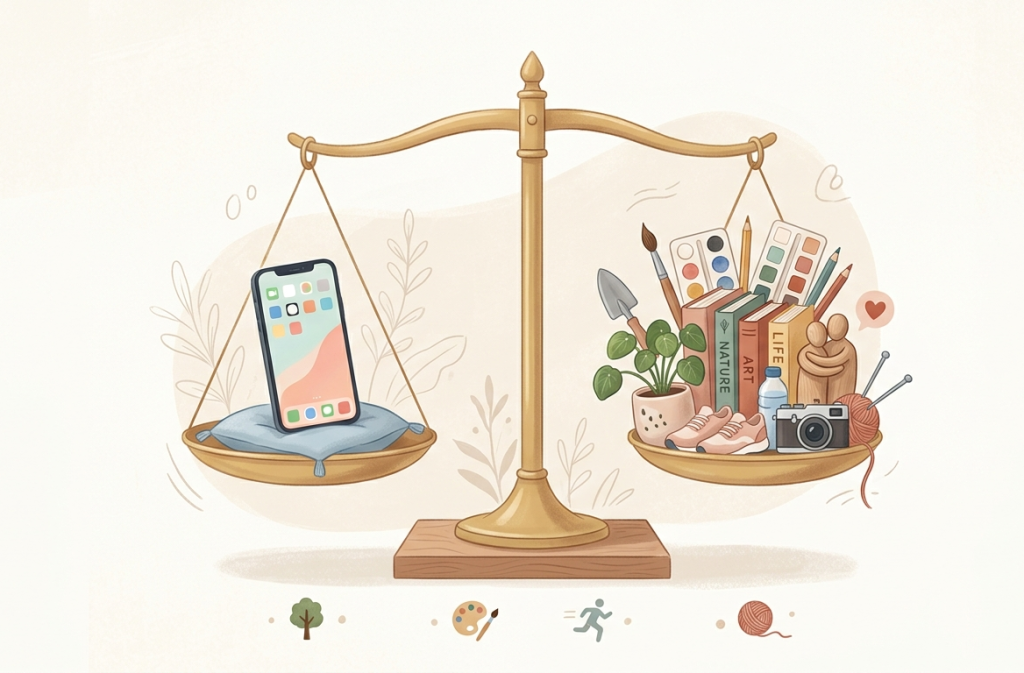
The question isn’t just how much is too much. It’s: what are you actually trading this time for?
What Experts Actually Recommend (And Why It’s Not That Simple)
Here’s the honest answer: no global health authority has set a hard daily limit for adult phone use. The World Health Organization has clear screen time guidelines for children under 5. The American Academy of Pediatrics has updated frameworks for teens. But for adults, the guidance is much softer – and most experts acknowledge why.
The phone isn’t one thing. It’s a work tool, a camera, a map, a way to stay connected to aging parents and far-away friends, a source of news, a reading device, a meditation timer. Treating all phone use as equivalent is like saying “all eating is bad” because some foods are.
That said, the emerging consensus is clear enough to be actionable:
Recreational phone use – scrolling social media, watching short-form video, browsing without purpose – should ideally stay under 2 to 3 hours per day. Beyond that threshold, research starts to show meaningful increases in eye strain, disrupted sleep, anxiety, and reduced attention span.
One 2018 study found that limiting social media use to fewer than 30 minutes a day measurably reduced feelings of loneliness and depression. Research from 2025 on problematic smartphone use links excessive use to dopaminergic dysregulation – essentially, your brain’s reward circuitry gets recalibrated in ways that make real-world activities feel less rewarding by comparison.
Most significantly, a 2025 randomized controlled trial published in BMC Medicine (Pieh et al.) tested what actually happens when people reduce phone use to 2 hours per day. The trial ran for three weeks with healthy young adults who were using their phones more than 3 hours daily. The results were clear: the group that reduced their usage showed significant improvements in well-being, depressive symptoms, stress, and sleep quality compared to the control group. Crucially, when the intervention ended and phone use returned to previous levels, the mental health gains started to reverse – suggesting the relationship is genuinely causal, not merely correlational.
The hard part is that most people’s “recreational” use is woven invisibly through their day – not a single 3-hour block, but dozens of 2-minute grabs that add up.
The Science Behind Why It’s So Hard to Stop
Your phone wasn’t designed to be easy to put down. Every notification, every like, every new piece of content in a feed is a small, unpredictable reward – and unpredictable rewards are neurologically the most addictive kind. Slot machines work on the same principle.
When you check your phone, your brain releases a small hit of dopamine – the neurotransmitter associated with anticipation and reward. Counseling psychologist Dennis Buttimer explains it plainly: “The problem is this dopamine boost is temporary and leads to a letdown. Our brains want more dopamine, which triggers the habit of checking our phones constantly throughout the day.” You can read more about these hidden focus triggers and how they keep you locked in the scroll.
Over time, with sustained overuse, this dopamine signaling can become dysregulated. The threshold keeps rising. Things that used to bring pleasure – a walk outside, a long conversation, a slow meal – begin to feel understimulating. The phone becomes the default because everything else feels too slow.
This isn’t a willpower failure. It’s a design outcome.
The apps competing for your attention have teams of engineers, behavioral psychologists, and billions of dollars optimizing for one metric: time on platform. You – trying to moderate on your own with good intentions – are not a fair match. Research confirms that excessive smartphone use weakens self-control circuitry over time, making moderation progressively harder without structural help.
Which is why the solution isn’t trying harder. It’s changing the environment. If you’ve already tried app blockers and found them falling short, here’s why they often fail – and what actually works instead.
Signs Your Phone Time Has Crossed a Line
Before getting into numbers, it helps to look at the behavioral signals. These are the real indicators that your relationship with your phone needs recalibration:
- You reach for your phone automatically. Not because you need something specific – but as a reflex. Waiting in line, sitting in silence, even mid-conversation. The discomfort of a blank moment now triggers an automatic reach.
- You feel worse after using it, not better. Scrolling social media for 20 minutes and feeling vaguely anxious, irritable, or inadequate afterward is not neutral. That emotional residue is data.
- Your sleep is affected. Screens at night suppress melatonin production. If you’re using your phone within 30 to 60 minutes of sleep – especially social apps – you are measurably shortening your deep sleep. This compounds over days and weeks.
- You check it during things that used to hold your full attention. A movie, a meal, a conversation. If those activities now feel hard to engage with without a side of scrolling, your attention threshold has shifted.
- You’ve lost track of time repeatedly. You opened the phone to check one thing. Forty-five minutes passed. You don’t clearly remember what you did.
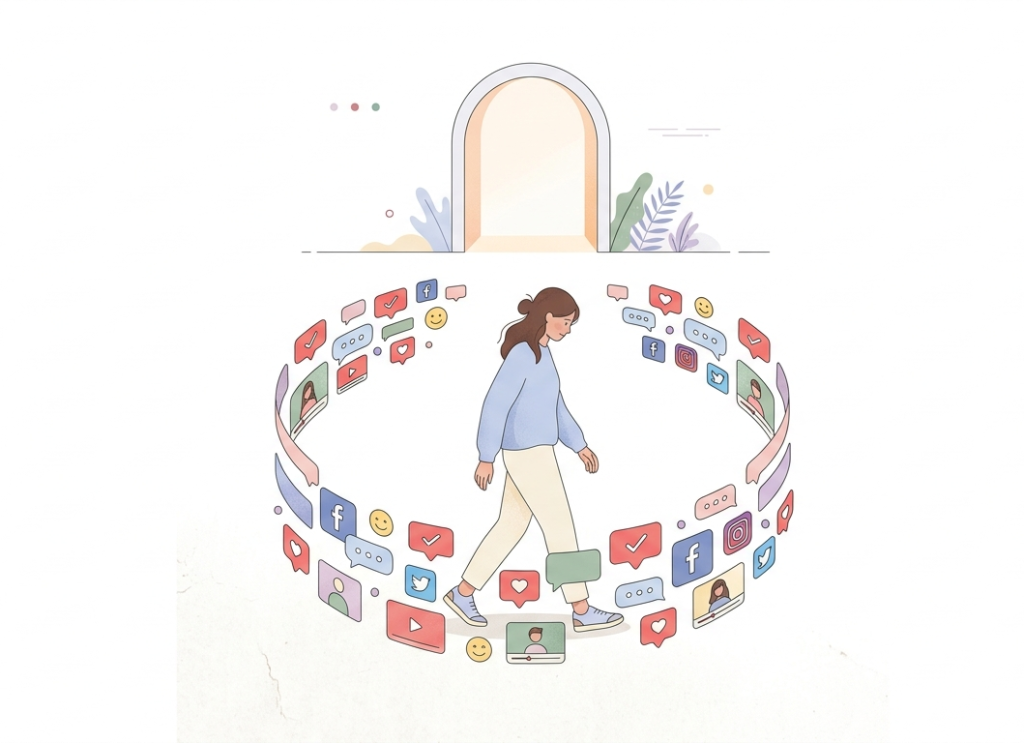
Any one of these patterns is worth paying attention to. Several of them together? That’s the signal that something structural needs to change – not just willpower.s the signal that something structural needs to change – not just willpower.
How Much Time Is Actually Right for You?
Because this is genuinely personal, here’s a framework that’s more useful than a single number:
- Step 1: Find your baseline. Before making any changes, check your actual numbers. On iPhone: Settings → Screen Time. On Android: Settings → Digital Wellbeing. Look at the weekly report. Most people find this number is higher than they expected – sometimes significantly so. If you’ve been tracking your time but still feel distracted, this guide explains what’s missing.
- Step 2: Separate intentional from habitual use. Go through your most-used apps. For each one, ask: “Is this serving me, or am I serving it?” Video calls with family – serving you. Thirty-minute social media rabbit holes triggered by a single notification – not so much.
- Step 3: Set a personal target, not a universal one. If you work remotely and rely on your phone for calls, Slack, and calendar, 4 to 5 hours of total use may be unavoidable and fine. If your phone use is mostly recreational and it’s eating 5+ hours of your day, even cutting to 3 hours would be a meaningful gain. The goal is deliberate reduction, not perfection.
- Step 4: Use time of day, not just total hours, as a guide. Many researchers point to when you use your phone as being as important as how long. Morning phone use before you’ve done anything else can set a scattered, reactive tone for the whole day. Nighttime use undermines sleep. Protecting the first 30 minutes after waking and the last 60 minutes before sleeping has an outsized effect on focus and mood.
What 2 Hours a Day Looks Like in Practice
If you’re currently at 5+ hours and the idea of cutting to 2 feels impossible, it helps to make it concrete.
Two hours a day – 120 minutes – is plenty of time for:
- Checking messages and responding to them fully (20-30 minutes)
- Reading the news or newsletters you actually care about (15-20 minutes)
- A deliberate social media check – not a scroll, but a purposeful visit (15 minutes)
- Navigation, maps, quick lookups throughout the day (10-15 minutes)
- A phone call with someone you love (20-30 minutes)
What that two-hour model cuts almost entirely: passive scrolling, algorithm-driven video consumption, reflexive checking, and the kind of browsing that doesn’t leave you having actually found or read anything.
That’s not deprivation. That’s most of what eats up the time.
Practical Ways to Actually Change the Habit
Understanding that you use your phone too much is not the same as being able to stop. Knowledge alone rarely changes behavior – if it did, no one who knew cigarettes caused cancer would still smoke. What actually works is changing your environment so that the right behavior becomes easier than the wrong one.
Here are the structural changes that hold up in research and in practice:
Start with your riskiest window, not your whole day
Most people don’t scroll equally across the day. There’s usually a peak window – late night, first thing in the morning, or the dead zone between tasks at work. Identify yours from your Screen Time weekly breakdown, then target only that window first. Trying to cut usage across all hours simultaneously almost always fails. Cutting one specific period has a much higher success rate and often reduces total daily use as a side effect.
Remove the apps that account for most of your time
The Pareto principle applies here: for most people, 2 or 3 apps account for 80% of their recreational phone time. Deleting – not just disabling, but deleting – those apps from your phone and accessing them via desktop browser only introduces enough friction to break the automatic loop. You can still use the platforms. You just can’t mindlessly open them while standing in line. The added steps between impulse and action are often enough.
Use your phone’s tools against itself
Both iOS Screen Time and Android Digital Wellbeing allow you to set hard per-app daily limits with a passcode that someone else sets for you. This is more effective than limits you can override yourself, because it removes the in-the-moment negotiation between your tired evening brain and the app. A 2022 randomized controlled trial published in the International Journal of Mental Health and Addiction found that a structured nudge-based intervention reduced problematic smartphone use and improved sleep quality, with effects sustained at 6-week follow-up. The intervention group returned to normal usage levels – something willpower-only approaches rarely achieve.
Create phone-free anchors in your day
Designate at least two periods each day as phone-free by default, not as an exception: the first 30 minutes after waking (before the phone has a chance to set a reactive tone for your day) and the last 60 minutes before sleep (for the melatonin and cognitive wind-down reasons discussed above). Charger in another room is the single most effective enforcement mechanism – if you have to get up to get it, you won’t.
A meal without your phone nearby – even one meal a day – is worth more than most people expect. Eating while scrolling is associated with reduced satiety awareness and consistently longer session lengths that extend well past the meal.
Track weekly, not daily
Obsessively checking your Screen Time every hour tends to create anxiety rather than change. A better rhythm is a weekly review every Sunday: look at last week’s total and top apps, note whether it went up or down, and set one specific intention for the coming week. This turns the habit into a system rather than a struggle.
The goal is not to hit a specific number on any given day. It’s to establish a slow, consistent downward trend over weeks and months – the kind of change that compounds into a genuinely different relationship with your phone rather than a white-knuckle restriction that bounces back the moment your guard drops.
A Note on Social Media Specifically
The research on social media use and mental health is substantial enough to warrant its own category. A 2025 analysis found that social media engagement is associated with up to a 60% increase in anxiety and depression risk for heavy users. Research shows 62% of users feel inadequate when comparing their lives to others’ curated presentations online.
This doesn’t mean social media is inherently harmful – it means the default mode of passive, comparative scrolling is. Using social media to actively connect – to message someone, to share something, to engage in a community – is a different behavior with different outcomes than using it to silently consume a feed designed to make you keep scrolling.
If Instagram is your highest-usage app, our guide on how to stop using Instagram walks through the specific patterns and exit strategies for that platform. If social media is your highest-use category more broadly, applying the 30-minute daily limit there specifically tends to have the greatest impact on overall mood and focus.
For Different Life Situations
- If you work from home or in a tech role:
Your total phone time will naturally be higher due to work requirements. Focus less on total hours and more on separating work use from recreational use – different apps, different times, different contexts. Consider a “shutdown ritual” at the end of your workday that also includes putting the phone aside for an hour. - If you’re a parent trying to model better habits:
Children notice what adults do, not just what they say. Research consistently shows that parents’ own phone habits influence children’s relationship with screens more than any formal restriction. The most powerful thing you can do for your kids’ digital habits is to improve your own – visibly. If you’re also navigating how much screen time a 12-year-old should have, that guide covers the age-specific research in detail. - If you have ADHD or high baseline anxiety:
The dopamine dynamics of phone use hit differently when your brain already has a sensitive reward system. Many people with ADHD report that their phone use is harder to moderate – not because of a lack of willpower, but because the neurological pull is genuinely stronger. Structural solutions (limits, grayscale mode, app removal) work better than intention-based ones. Our deeper guide on breaking phone addiction with ADHD covers the specific strategies that work for this profile. - If you’re a student:
Academic research consistently links high phone use with lower grades, reduced sleep quality, and poorer attention during study. Keeping your phone in a different room while studying – not just face-down on the desk – produces measurably better focus outcomes.
The Real Goal: A Healthy Relationship With Your Phone
The goal isn’t to demonize your phone or to spend as little time on it as possible. It’s to be the one in charge.
A healthy relationship with your phone looks like: picking it up with a purpose, using it for that purpose, and putting it down. It looks like checking in on your screen time numbers monthly – not obsessively, but with the same casual curiosity you might apply to a budget. It looks like noticing when your usage creeps up during stressful periods, and understanding that reaching for your phone more when you’re stressed is the same thing as reaching for any other comfort behavior.
It’s not about the two-hour benchmark as a moral standard. It’s about whether the time you spend on your phone is serving the life you actually want to be living.
That’s a question worth asking honestly – and answering honestly – more than once.
We Want to Hear From You
Phone habits are deeply personal – and we learn more from real stories than from averages.
- Has reducing your screen time affected your sleep, focus, or mood? Tell us what changed.
- How much time do you spend on your phone each day? (Check your Screen Time or Digital Wellbeing right now – share the real number!)
- What’s the one habit change that made the biggest difference for your phone use?
- Do you think the “2-hour recommendation” is realistic for most people? Why or why not?
Frequently Asked Questions
There’s no single universal answer – but experts broadly agree that recreational (non-work) phone use over 2–3 hours per day starts to carry measurable health trade-offs, including sleep disruption, eye strain, and increased anxiety. The more meaningful question is whether your current phone use is intentional or habitual, and whether it’s leaving you better or worse off.
By current averages, it’s close to normal – Americans average just over 5 hours of phone use daily in 2025. But normal isn’t the same as healthy. Five hours of recreational phone use per day is significantly above what most health experts recommend for well-being. If much of that is work-related, the calculus changes – but it’s still worth auditing what the time is actually going toward.
Sustained overuse affects dopamine signaling – the brain’s reward circuitry gradually recalibrates, making it harder to find satisfaction in slower, real-world activities. Research also links excessive phone use to reduced prefrontal cortex activity (the part of the brain involved in impulse control and focus), disrupted sleep architecture, and increased baseline anxiety. These effects are reversible with sustained change.
On iPhone: Settings → Screen Time. On Android: Settings → Digital Wellbeing and Parental Controls. Both show daily and weekly averages, broken down by app. Most people who look at these numbers for the first time are genuinely surprised by what they find.
If your current use is primarily recreational and you work at a desk with a separate computer, yes – with structural changes rather than willpower. If you work from your phone, 2 hours of total use may not be realistic, but 2 hours of recreational use is achievable for most people. Start by identifying your highest-use apps and applying a specific limit to those, rather than trying to cut everything at once.
Yes – meaningfully. Screen light (especially in the blue spectrum) suppresses melatonin production, which delays the onset of sleep. But beyond the light itself, the content matters too: checking social media or news before bed activates the arousal system in ways that make it harder to wind down. Nighttime use has been linked to sleeping 24 fewer minutes per hour of use – a real and compounding deficit over weeks.