

It’s 11:40 on a Tuesday. You’re in bed, phone six inches from your face, and someone you’ve never met is saying something so confidently wrong that your jaw actually tightens. Your thumb is already moving toward the reply box. You haven’t decided to respond. You’re just responding.
Here’s the part that might surprise you: people who get rewarded with likes and shares for outrage don’t just feel angrier in the moment. They produce more outrage over time because the platform taught them to. That’s not a personal failing. That’s a design working exactly as intended.
The term for what just happened to you is rage bait, and it was Oxford’s word of the year for 2025. Most explainers stop at “notice it and walk away.” That advice isn’t wrong. It skips the part that actually matters: why the walking away is so hard to do in the exact moment you need to do it.
What Is Rage Bait, Really?
Rage bait is content built specifically to make you angry enough to engage with it. Not curious, like clickbait. Angry. A comment, a video, a headline, engineered so that clicking, replying, or quoting it feels almost involuntary.
Here’s the twist most articles skip: the person who posted it doesn’t have to be angry at all. A 2026 UBC study on digital anger found rage-baiting content is often manufactured purely for the viewer’s reaction. The creator can be calm and calculating while you’re the one lying awake with your heart rate up.
So if you’ve ever felt a little embarrassed about getting worked up over some stranger’s terrible take, sit with this for a second. You weren’t tricked because you’re gullible. Something built and tested to work on people exactly like you did its job.
If this pattern feels bigger than just rage bait, being chronically online is the wider version of it.

Why It Works on You
Social platforms don’t distinguish between “I love this” and “this is the worst thing I’ve ever seen.” Both are engagement. Both get pushed to more people. Anger, it turns out, is one of the most reliable engagement generators there is.
The numbers back this up. One extra negative word in a headline raises click-through rate by 2.3%.
A small rise in anger-content produces an outsized effect too: a 0.1 increase generates about six more retweets.
And each moral-emotional word added to a post increases its spread by roughly 20%. None of these numbers look dramatic alone. Compounded across a platform with billions of posts, they tilt a feed toward whatever makes you feel something sharp.
That Yale finding from the intro explains why this doesn’t feel like getting fooled once. It feels like slowly noticing your own feed has changed. Users who got above-average engagement for an outraged post were more likely to post something outraged again. Small effect per post, compounding over months. That’s rage farming: not a single viral trick, but a sustained planting of provocation designed to keep an audience coming back angry. It’s the same reward-chasing pattern behind a lot of compulsive scrolling, which is why a dopamine reset helps with more than just rage bait.
Why “Just Pause” Doesn’t Work
Nearly every article on this topic ends with some version of the same advice. Notice the trigger. Take a breath. Count to ten before you respond.
It’s not bad advice. It’s just aimed at a version of you that mostly exists in the morning.
Self-control isn’t a flat resource you carry around at full strength all day. By evening, cortisol, which helps keep your stress response in check, has dropped to its lowest point. Meanwhile a fatigue compound called adenosine builds up since you woke, specifically dulling the brain region tied to willpower.
Rage bait tends to hit hardest at precisely this low point. Late at night. After a long day. Mid-scroll, when you’ve already spent your best decision-making hours on smaller things you don’t even remember choosing. Asking yourself to out-willpower a system built around this exact kind of depletion is a rigged fight. Losing it isn’t really on you. If that rings true well beyond rage bait, staying disciplined without relying on willpower walks through why more generally.
A different approach helps more than another reminder to breathe. Instead of catching the reflex in the moment, comfortzonecheckin’s approach to habit patterns is built around catching a loop early, before it turns into another lost hour.
Recognizing It Before It Hooks You
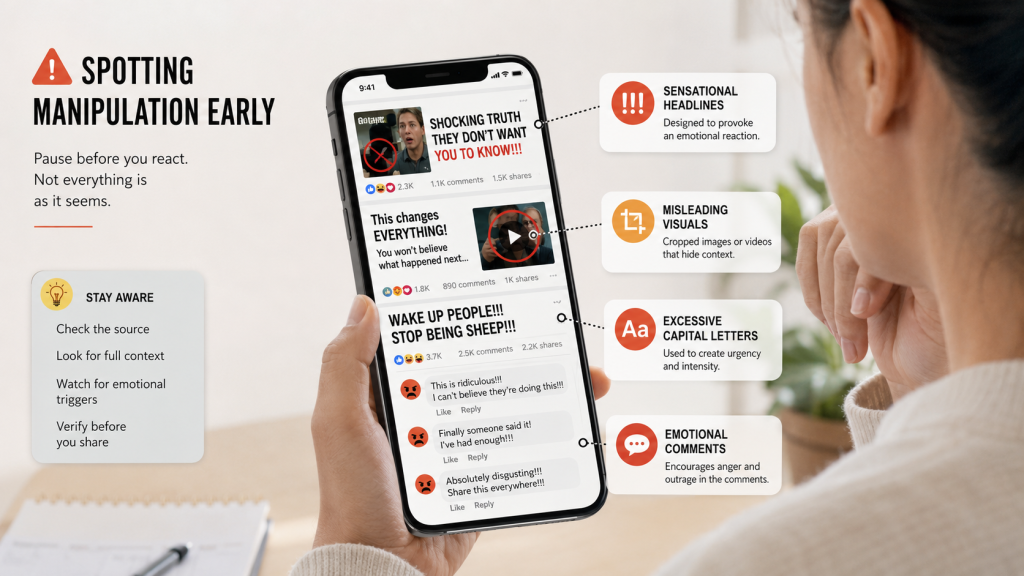
Some patterns repeat once you know to look for them. A hot take said with total confidence, no hint that anyone might disagree. A staged fight with a stranger, edited to look spontaneous. A ten-second clip cut from a much longer talk, stripped of the context that would calm the whole thing down. A real statistic framed to make you mad about the wrong thing. Even the visual presentation can play a role, with attention-grabbing graphics, bold layouts, or design templates used to make provocative posts stand out in an already crowded feed.
There’s a newer wrinkle too: some viral clash videos are staged, built as repeatable, low-stakes conflict dressed up as moral drama.
A growing share of rage bait has no person behind it at all. Academic work on AI-made provocation found posts built to spark outrage with no human creator involved.
Honestly, the content itself is rarely the tell. Your own reaction time is. Typing a reply before you’ve even finished reading the post? That’s the signal worth trusting, not whatever the post claims to be about.
What Actually Helps: Redesigning the Moment of Contact
Here’s the reframe that matters most. The goal isn’t more willpower in the moment. It’s changing what you’re even reacting to in the first place, before the moment arrives.
Mute or unfollow at a structural level instead of deciding in the moment. Build a delay before you can reply to anything that spikes your heart rate. Evenings are exactly when this content does the most damage, which is often why a social media detox alone doesn’t stick: it still leans on willpower at the worst possible hour.
A 2020 study found that simply teaching people how manipulation tactics work made them more resistant afterward. Understanding the mechanism is part of the fix, not just background reading. This is the thinking behind CZC’s Loop Detection: naming the pattern early enough to interrupt it, instead of white-knuckling through the moment it’s built to exploit.
When It’s Coming From People You Love
Rage bait isn’t only a stranger-on-the-internet problem. The same shape shows up closer to home. A deliberately pointed comment dropped into a family group chat. A partner who somehow always knows which old argument will get a reaction. The mechanic is identical to the algorithmic version, just running at a smaller scale: reacting gives the other person exactly the response they were fishing for.
It matters to tell the difference between a one-off provocation and a repeated pattern. A single frustrating comment from a relative is just a frustrating comment. Something constant, aimed specifically at destabilizing you, is a different and more serious conversation, worth having outside the heat of the moment, not inside the group chat itself.
You can’t unfollow a family member. But you can decide not to reply the second you feel that familiar spike, and bring it up later, when they don’t get the immediate payoff of watching you fold in real time. The same redirect-early logic behind a real social media break applies here too, just aimed at a person instead of a feed.

A Few Practical Steps to Start With
You don’t need to overhaul everything at once. A few places to start:
- Mute or unfollow at the account level, not just the individual post, so you’re not making the same decision every time.
- Build a real delay before you can reply to anything that spiked your heart rate. Even ten seconds changes the outcome more often than it feels like it should.
- Pick one evening this week to just notice, without trying to fix anything yet, which posts get a reaction out of you and roughly what time it happens.
- If the provocation is coming from someone you know, decide in advance that you won’t respond inside the thread where it happened.
None of these require more willpower than you currently have. That’s the point.
Conclusion
Go back to that Tuesday night scroll from the beginning. The post is still designed the same way. Your evening brain is still running on the same depleted battery it always is by then. What’s different now is that you have language for what’s actually happening, and a reason to stop blaming yourself for a fight that was never fair to begin with.
Frequently Asked Questions
Rage bait is online content built specifically to make you angry enough to click, comment, or share it. The anger is the intended reaction, not a side effect.
They’re related but not identical. Clickbait uses curiosity to get a click. Rage bait uses anger instead, which tends to generate even more engagement because platforms treat outraged reactions the same as positive ones.
Willpower isn’t constant throughout the day. It’s lowest exactly when rage bait tends to hit hardest: evening, after a long day, mid-scroll. Knowing the trick exists doesn’t fully protect you if the moment catches you already depleted.
Mute or unfollow at the account level rather than reacting post by post, and build a short delay before you can reply to anything that spikes your heart rate. Structural changes hold up better than in-the-moment willpower.
Notice whether it’s a one-off comment or a repeated pattern aimed at getting a reaction. For the pattern version, avoid responding inside the moment it happens, and raise it separately, when you’re not already reacting.