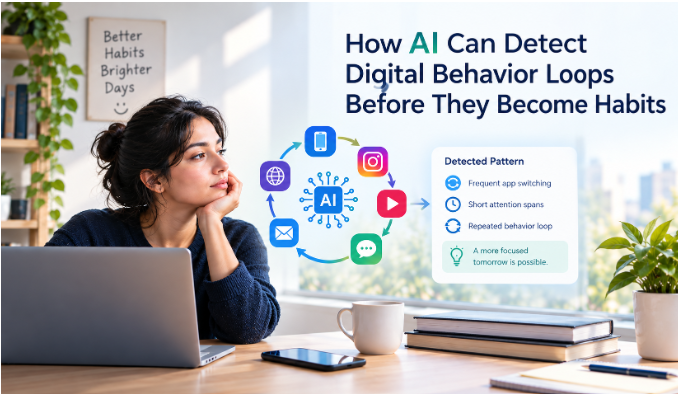
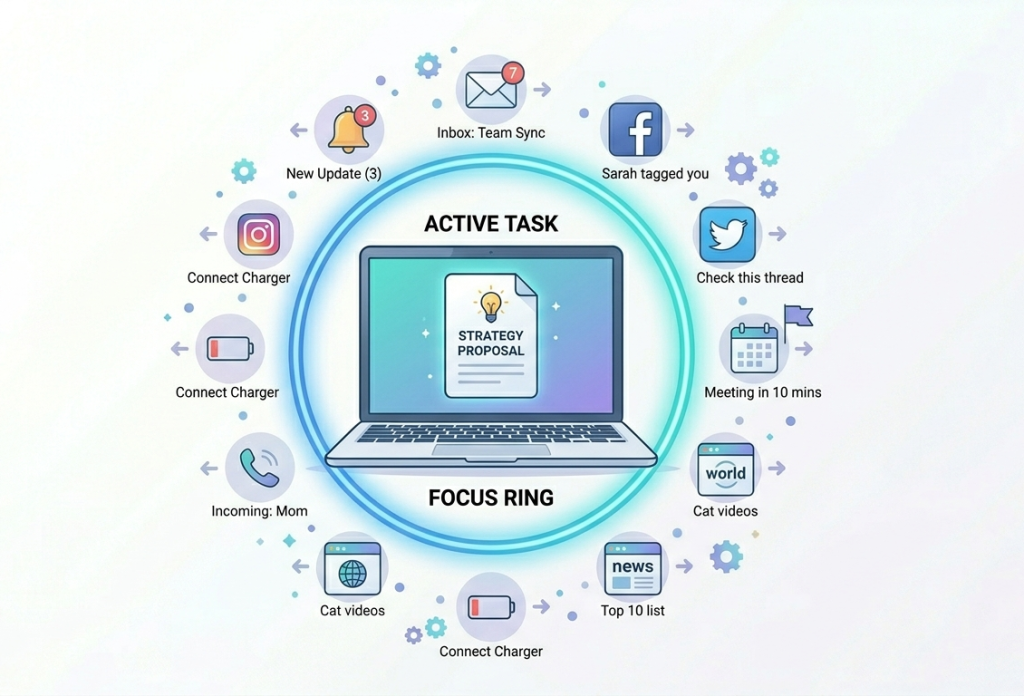
There’s a reason your attention feels weaker than it used to, and it’s not just because you’re “more distracted” or “less disciplined.” Your environment has changed faster than your brain can adapt. Every notification, every scroll, every tab you open is competing for the same limited cognitive resource: your attention.
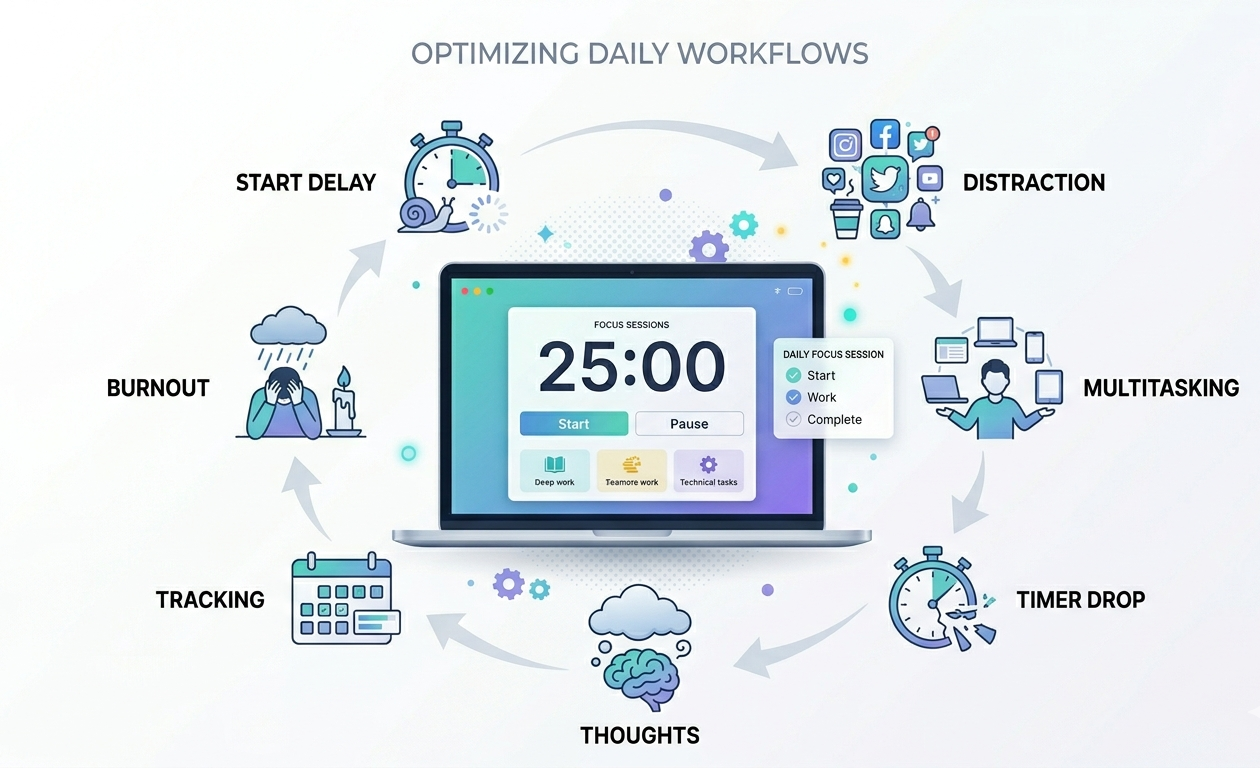
The problem is, most advice treats focus like a single switch either you have it, or you don’t. In reality, focus behaves more like a chain. And like any chain, it breaks at specific points.
If you’ve ever said:
- “I just can’t start”
- “I lose focus after a few minutes”
- “I keep jumping between tasks”
- “I feel tired and avoid work”
…you’re not describing one problem. You’re describing different moments where your attention collapses.
That’s why apps to improve attention span are most effective when they target these exact breakdowns instead of trying to “fix everything.”
Let’s go deeper into how this works.
Your Focus Problem Has a Pattern
Why you lose focus at specific moments (not randomly)
Focus doesn’t disappear randomly. It follows patterns shaped by three main factors:
- Cognitive load – How mentally demanding the task is
- Emotional resistance – How you feel about the task
- Energy levels – How rested and alert your brain is
For example:
- You avoid starting because the task feels unclear or overwhelming
- You drift because the task lacks stimulation
- You switch tasks because something feels uncomfortable or difficult
- You burn out because you’ve pushed beyond your mental limits
Each of these is predictable. And predictability is powerful—because what’s predictable can be fixed.
The 7 common “focus breakpoints” in a workday
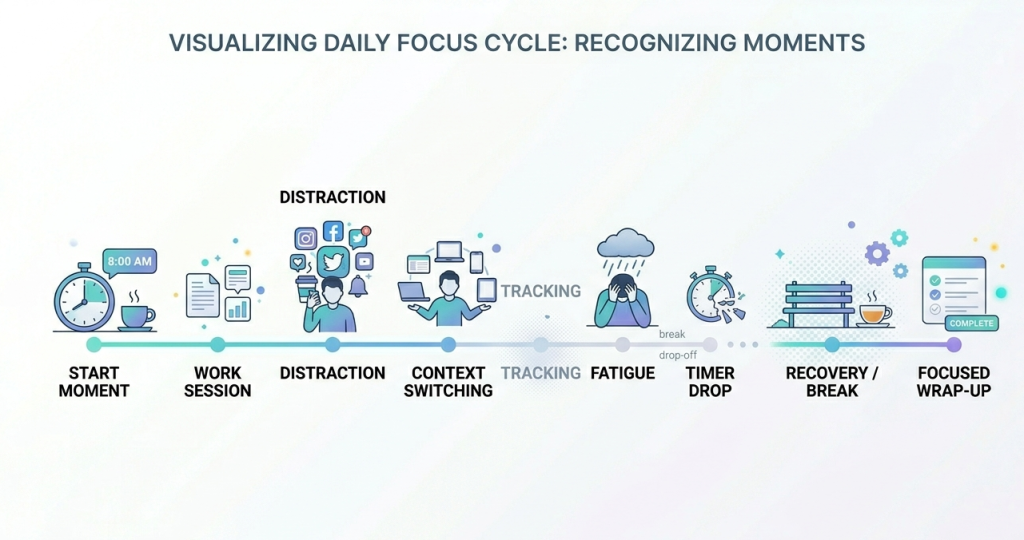
Across different professions and routines, most people experience focus loss at the same seven points:
- Initiation resistance – You can’t begin
- Early drift – You start but quickly disengage
- Task switching – You jump between tasks
- Attention fatigue – You lose focus after some time
- Internal distraction – Your own thoughts interrupt you
- Unconscious distraction – You don’t even notice losing focus
- Burnout avoidance – You feel too drained to continue
These are not personality flaws—they are neurological patterns.
How fixing each moment is easier than fixing everything
Trying to “be more focused” is too vague. It creates pressure without direction.
But solving one moment is specific and actionable.
Instead of:
“I need to focus better”
You shift to:
“I need help starting my work”
or
“I need to stop switching tasks”
This clarity reduces overwhelm and increases success.
And this is exactly where the right apps to improve attention span make a difference—they act as targeted interventions.
Moment 1: You Can’t Start
Why starting feels overwhelming
Starting is psychologically heavy because it requires:
- Decision-making
- Mental activation
- Facing uncertainty
If a task is unclear or large, your brain interprets it as a threat. It prefers certainty and quick rewards, so it nudges you toward easier actions—checking messages, scrolling, or doing low-effort tasks.
This creates a loop:
Avoid → Feel guilty → Avoid more
App that helps you begin: Centered
Centered reduces this friction by easing you into focus instead of forcing it.
It works by:
- Asking you to define your intention clearly
- Using voice prompts and reminders to anchor your attention
- Bringing you back when your focus drifts
What makes it effective is the transition it creates. Instead of jumping from distraction to deep work, it builds a bridge between the two.
Over time, your brain starts associating “starting” with structure instead of stress. That alone can significantly improve your attention span.
Moment 2: You Start but Drift Away Quickly
Why your brain looks for distractions instantly
Your brain is wired to seek novelty and minimize effort. When you begin a task that feels repetitive or demanding, it quickly searches for alternatives that provide faster rewards.
This is why:
- You check your phone without thinking
- You open new tabs “just for a second”
- You lose track of what you were doing
This isn’t a lack of willpower—it’s an automatic response.
App that keeps you aware: Engross
Engross introduces a crucial missing element: awareness.
It allows you to:
- Tap whenever you get distracted
- Track how often interruptions occur
- Review your distraction patterns
This simple act of noticing changes behavior.
You go from:
“I got distracted again”
to:
“I got distracted 12 times in 20 minutes”
That shift creates accountability. And accountability strengthens focus.
Over time, you train your brain to stay longer on tasks because you’re actively monitoring your attention.
Moment 3: You Keep Switching Tasks
Why multitasking destroys deep focus
Multitasking feels efficient, but it comes with hidden costs. For business owners, this breakpoint is often structural, not behavioral – managing invoices in one tab, expenses in another, and inventory in a third. Consolidating into a single platform like Enerpize removes the trigger before it becomes a focus problem.
Every time you switch tasks:
- Your brain takes time to reorient
- You lose context
- You reduce depth of thinking
This is called attention residue—a part of your mind stays stuck on the previous task.
As a result, even if you’re “working all day,” your output remains shallow.
App that enforces single-tasking: Sunsama
Sunsama helps you break this cycle by introducing intentional planning.
Instead of overwhelming you with tasks, it:
- Encourages realistic daily goals
- Guides you through tasks sequentially
- Limits how much you take on
It’s not just a planner—it’s a behavioral system.
By reducing task overload, it removes the urge to switch. And when you focus on one task at a time, your attention naturally deepens.
Moment 4: You Lose Focus After 20–30 Minutes
Why your attention drops naturally
Your brain operates in cycles. After a certain period of focus, mental fatigue sets in.
Without structure, this leads to:
- Mind wandering
- Checking distractions
- Losing momentum
But this dip isn’t a problem—it’s an opportunity to reset.
App that builds focus stamina: Flow
Flow uses timed work sessions to align with your brain’s natural rhythms.
It helps you:
- Work in focused intervals
- Take intentional breaks
- Gradually extend your focus duration
This builds what you can call “attention endurance.”
Instead of forcing long hours, you train your brain step by step. Over time, you’ll notice you can focus longer without feeling drained.
Moment 5: You Get Distracted by Your Own Thoughts
Internal distractions are harder to control
External distractions can be blocked. Internal ones cannot.
Your mind might wander due to:
- Stress
- Anxiety
- Random ideas
- Overthinking
And once a thought hooks you, it can pull you away for minutes—or longer.
App that clears your mind: Headspace
Headspace strengthens your ability to return to focus.
Through mindfulness training, it teaches you to:
- Notice thoughts without engaging them
- Let distractions pass naturally
- Bring your attention back to the present
This is a long-term skill.
You’re not eliminating thoughts—you’re reducing their control over your attention. And that makes a huge difference in sustained focus.
Moment 6: You Don’t Realize You’re Distracted
Why lack of awareness is a big problem
One of the most dangerous aspects of distraction is that it often goes unnoticed.
You might believe you’ve been productive for hours—but in reality, much of that time was fragmented.
Without visibility, there’s no improvement. The same blind spot shows up in how we use social platforms. Research into social media silent scrollers found that most people watch, save, and privately share far more than they ever like or comment, so the time leaves no trace they can point at later. Distraction you never registered is the hardest kind to measure, which is exactly why tracking beats memory.
App that shows your real behavior: Timing
Timing provides objective insight into how you spend your time.
It automatically tracks:
- Apps you use
- Time spent on each activity
- Patterns across your day
This data reveals the truth.
You might discover:
- You switch tasks more than you thought
- You spend significant time on low-value activities
- Your focus peaks at specific times
With this knowledge, you can make smarter adjustments and strengthen your attention span.
Moment 7: You Burn Out and Avoid Work
Why burnout feels like laziness
When your energy drops too low, your brain resists effort entirely.
This can look like:
- Procrastination
- Avoidance
- Lack of motivation
But it’s not laziness, it’s protection.
Your brain is trying to recover.
App that balances energy and focus: Rise
Rise focuses on the biological side of attention.
It helps you understand:
- When your energy is highest
- When you’re likely to feel tired
- How sleep impacts your focus
By aligning your work with your natural rhythms, you reduce resistance.
Instead of forcing productivity at the wrong time, you work when your brain is ready—leading to better focus with less effort.
How to Use These Apps Without Overwhelm
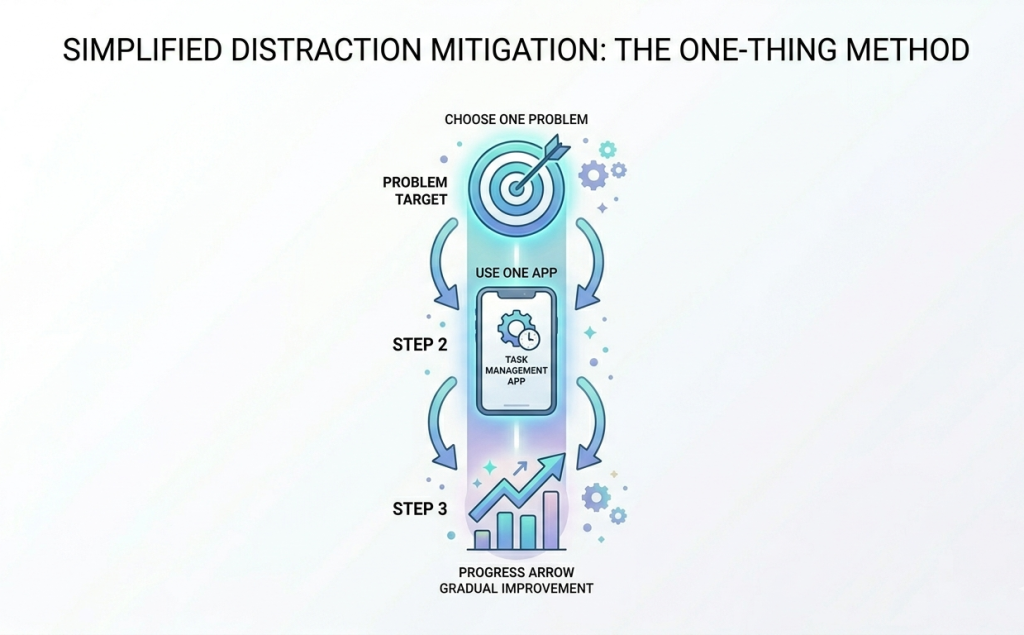
Pick one problem, not all seven
You don’t need to fix everything at once.
Start by identifying your biggest struggle:
- Can’t start?
- Lose focus quickly?
- Switch tasks too much?
Focus on that one issue first.
Use one app for a week
Consistency matters more than variety.
Use one app daily:
- Observe your behavior
- Notice improvements
- Build a habit
This creates a foundation for stronger attention.
Then improve gradually
Once one area improves, move to the next.
This layered approach leads to:
- Better focus sessions
- Reduced distractions
- Increased productivity
- Sustainable mental energy
Over time, your attention system becomes stronger and more reliable.
Conclusion
Focus is not a single ability; it’s a collection of small, trainable behaviors.
Every time your attention breaks, it’s happening at a specific moment for a specific reason. When you identify that reason, you can apply the right solution.
The best apps to improve attention span don’t overwhelm you with features. They solve precise problems:
- Starting
- Staying
- Continuing
- Recovering
And when you fix even one of these moments, your entire day begins to shift.
So instead of chasing perfect focus, aim for better moments of focus.
Because in the end, your ability to concentrate isn’t built in one big change—it’s built in small, consistent wins.