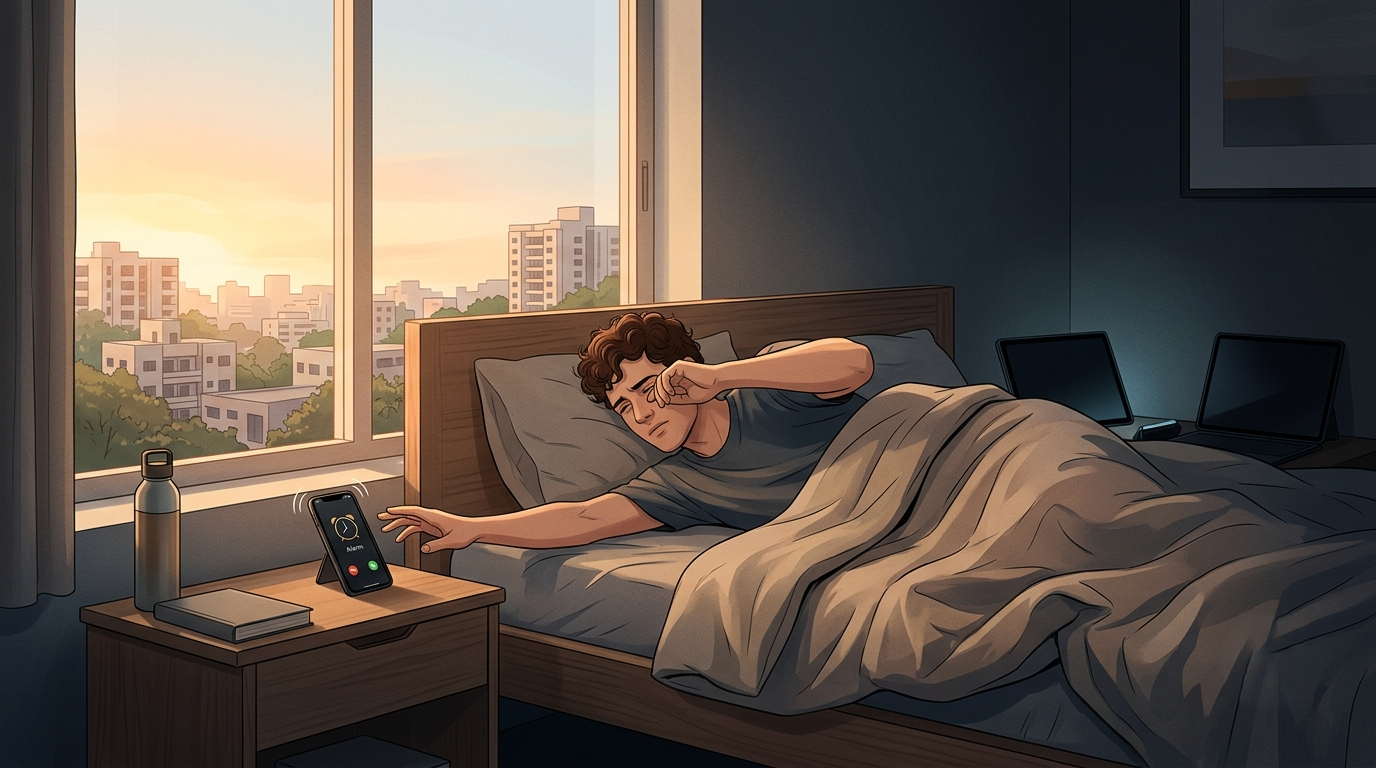
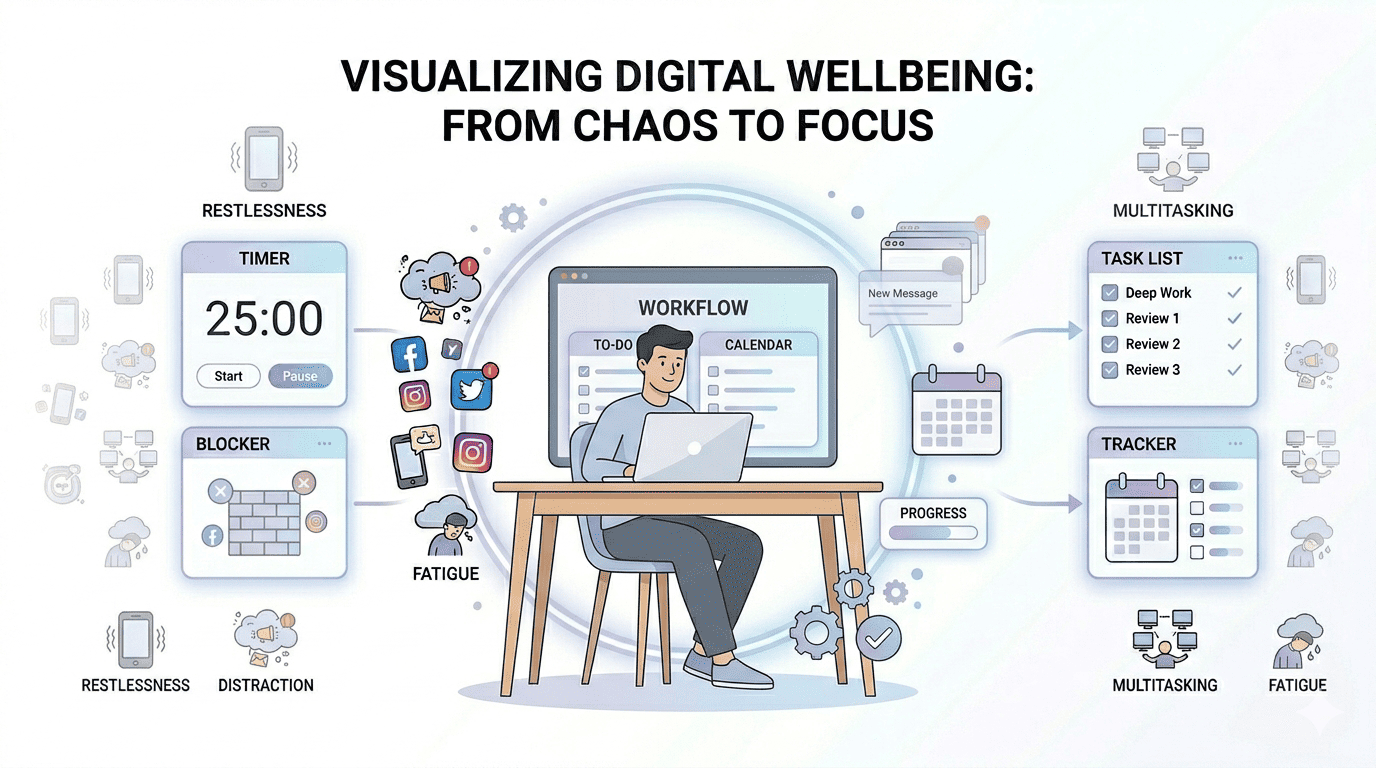
You’ve done the things. You silenced your notifications. You downloaded the app blocker. You tried Pomodoro timers, lo-fi playlists, and even moved your phone to another room. And still, ten minutes into something important, you’re somewhere else entirely.
If you feel easily distracted no matter what you try, you’re not broken. And you’re not lazy. But you might be solving the wrong problem.
Most focus advice treats distraction like a bad habit you can white-knuckle your way out of. But the reason you’re still distracted after trying everything isn’t a lack of effort. It’s that the tools you’ve been given are designed to fight symptoms, not causes. This post breaks down what’s actually going on, and what genuinely helps.
Quick Takeaways
- Your brain is biologically wired to seek novelty, distraction is not a personal failure
- “Attention residue” from unfinished tasks quietly destroys your focus between sessions
- App blockers and timers fail long-term because they rely on willpower, not design
- Awareness of your scroll patterns beats restriction every time
- A gentle nudge at the right moment is more effective than a hard block
Why “Just Try Harder” Doesn’t Work on Distraction
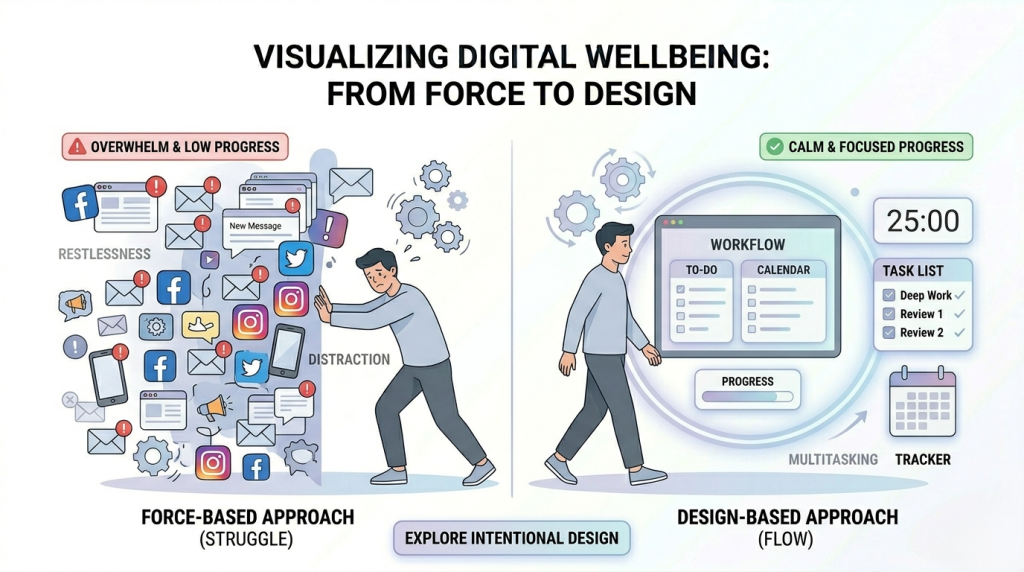
Here’s the frustrating truth: the more you rely on willpower to stay focused, the more likely you are to burn out and lose focus anyway. Willpower is a finite resource. It depletes throughout the day. And in a world engineered to hijack your attention at every turn, betting your productivity on self-discipline alone is an uphill battle you were never going to win consistently.
Your Brain Was Built to Be Distracted
This isn’t an excuse; it’s biology. Humans evolved in environments where staying alert to movement, sound, and change was literally a survival skill. Your attention system was designed to be reactive, not locked in. Research on human attention shows that modern focus demands a near-complete reversal of how our brains are naturally wired. We’re asking ancient hardware to run a very new kind of software.
Neuroscience research on attention networks confirms this mismatch: the brain’s default mode network, which activates during mind-wandering and self-referential thought is constantly competing with the task-positive network required for sustained focus. Digital environments are particularly effective at triggering the default mode network, which is why distraction online feels so effortless compared to staying on task.
The apps, feeds, and platforms you use every day know this. Their design is not accidental; it’s built around the same reactive attention system that kept your ancestors alive. Every notification, every infinite scroll, every autoplay is a carefully engineered nudge toward distraction.
The Myth of Willpower as a Focus Tool
Willpower works in short bursts. But studies show that nearly 79% of workers get distracted within the first hour of starting a task, and close to 59% can’t maintain focus for even 30 minutes. That’s not 79% of people failing. That’s a system that’s failing people.
Psychologists studying self-regulation describe this as an ego depletion effect, the psychological finding that acts of self-control draw on a shared cognitive resource that diminishes with use. While the original model has been refined by later research, the behavioral pattern is robust: sustained mental effort genuinely reduces the capacity for further self-regulation, which is why distraction gets harder to resist as the day goes on.
When you try to fight distraction with sheer discipline, turning off Wi-Fi, setting timers, punishing yourself for every slip, you’re treating focus like a moral virtue instead of a skill that needs the right environment to thrive. The result? You stay exhausted, guilty, and still distracted.
What’s Actually Keeping You Distracted (It’s Not What You Think)
If you’ve genuinely tried the standard advice and it hasn’t worked, the issue is likely operating below the surface. The two biggest hidden culprits are attention residue and misidentifying the root cause of your distraction.
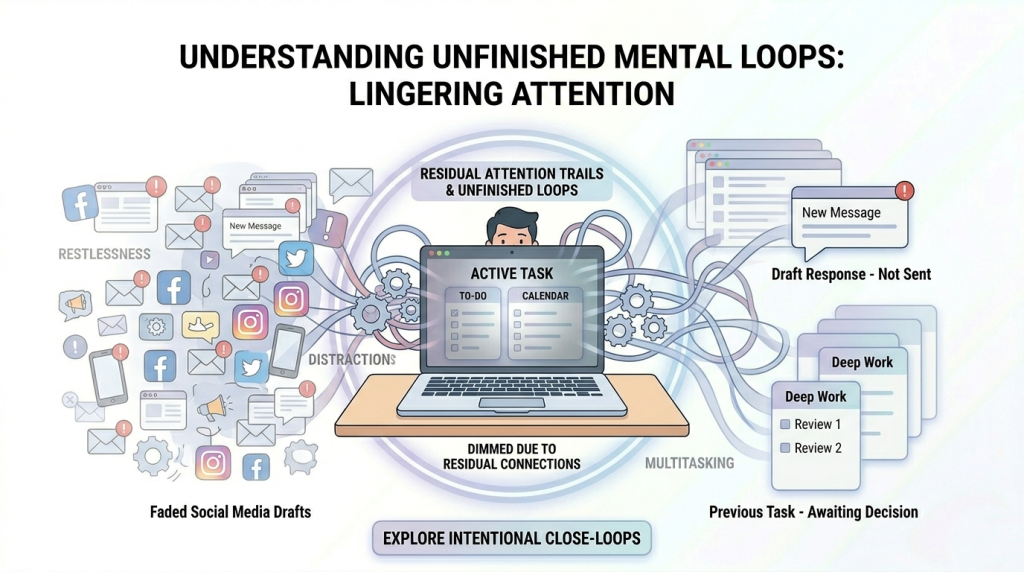
Researcher Dr. Sophie Leroy at the University of Washington coined the term attention residue to describe something you’ve probably felt but never had a name for. When you switch from one task to another, even if you’re “done” with the first one, part of your brain stays mentally tangled in it. That residue quietly competes for your cognitive resources on whatever you’re trying to do next.
This is a well-documented psychological phenomenon, part of a broader body of cognitive psychology research on task-switching costs. The finding has been replicated across multiple workplace studies and is now considered one of the most reliable explanations for why even motivated, capable people struggle to maintain focus in modern work environments.
This is why checking a single email “just for a second” can wreck the next 20 minutes of deep work. Her research found that people perform significantly worse on a second task when they switch away from an unfinished first one. The more complex the original task, the worse the drag.
And here’s the part most productivity advice misses: attention residue isn’t external. You can sit in a completely silent room and still experience it if you have just left an email half-written or a conversation unresolved. The distraction is already inside your head.
Are You Treating Symptoms, Not Causes?
Most focus tools, app blockers, website restrictions, and Pomodoro timers address what you can see: the open tab, the buzzing phone, the tempting app icon. But they don’t touch what’s underneath: the mental loops, the emotional avoidance, the low-level anxiety that makes your brain prefer a scroll session over a hard task.
One of the most underacknowledged causes of distraction is anxiety, specifically, task anxiety. When a piece of work feels overwhelming, uncertain, or carries a high cost of failure, the brain treats it as a mild threat. Scrolling, checking email, or switching to an easier task is a stress-relief behavior: it temporarily lowers the anxiety of sitting with something hard. This is why people with higher background stress or anxiety levels often struggle disproportionately with focus; it’s not a concentration problem, it’s an avoidance response to an uncomfortable emotional state. Addressing the anxiety directly, through breaking tasks into smaller steps, lowering the stakes of first drafts, or naming the fear explicitly, is often more effective than any external blocking tool.
According to Gloria Mark’s landmark peer-reviewed research at UC Irvine, published across multiple academic papers on workplace attention and digital interruption, it takes an average of 23 minutes and 15 seconds to fully regain deep focus after a single disruption. If you’re getting interrupted, or interrupting yourself, even four or five times a day, you’re losing hours of genuine productive time. Not to laziness. To biology and bad system design.
Why Are You Still Distracted After Trying Everything?
This is the question that needs a real answer, not a pep talk.
Is It ADHD or Just a Distracted Environment?
A lot of people who wonder if they have ADHD are actually living and working in environments that would make anyone struggle to focus. Open-plan offices, constant notifications, and context-switching between ten different tools are structurally hostile to sustained attention. Research shows that open-plan offices increase workplace distractions by roughly 25% compared to more private setups. There are many ADHD apps for focus and productivity.
That said, if you’ve genuinely tried adjusting your environment and still can’t focus consistently, it’s worth talking to a professional. ADHD is real, underdiagnosed in adults, and very treatable. Don’t let the label feel like a defeat; it can be a door to the right kind of support.
Persistent inability to focus, especially when it’s affecting your work, relationships, or overall mental wellbeing, is worth taking seriously as a health concern, not just a productivity problem. A mental health professional can help distinguish between environmental distraction, burnout, anxiety, and conditions like ADHD that respond to specific, targeted treatment.
Why Don’t App Blockers Fix the Problem Long-Term?
App blockers work on willpower by proxy. They remove the option, so you don’t have to resist it. That sounds smart, and for short periods, it is. But the moment the block lifts, the habit is still there unchanged. You haven’t rewired anything; you’ve just temporarily redirected it.
Sustainable focus doesn’t come from restriction. It comes from awareness, understanding when you slip into passive scrolling, what triggers it, and having a better option ready when it happens. That’s the difference between a hard block and what ComfortZoneCheckin calls an “exit ramp”, a gentle nudge after 20 minutes of passive dwell time that re-engages your prefrontal cortex and points you back toward the work that actually matters.
What Actually Moves the Needle on Focus
Once you stop trying to overpower distraction and start designing around it, things get easier, not overnight, but noticeably.
Designing Your Environment Instead of Fighting It
Neuroscience research suggests that simply keeping your phone in another room, not silenced, not face-down, but physically absent, reduces cognitive load by around 26%. You don’t have to resist checking it. The friction of having to get up does the work for you.
This is the core insight: design your environment so the path of least resistance leads toward focus, not away from it. That means pre-loading your work before you open a browser. It means closing unrelated tabs before starting something hard. It means making distraction slightly harder to reach, not impossible, just inconvenient enough to break the autopilot loop.
The Role of Awareness Before Action
Before you can fix a pattern, you have to see it clearly. Most people have no idea how often they drift into passive scrolling or what triggers it. Boredom? Anxiety about a hard task? A specific time of day? A particular type of work?
This is a foundational principle in behavioral psychology: metacognition, the ability to observe your own thinking patterns, is a prerequisite for changing them. You can’t redesign a system you can’t see. That’s why awareness-based interventions consistently outperform pure restriction strategies in psychological research on habit change.
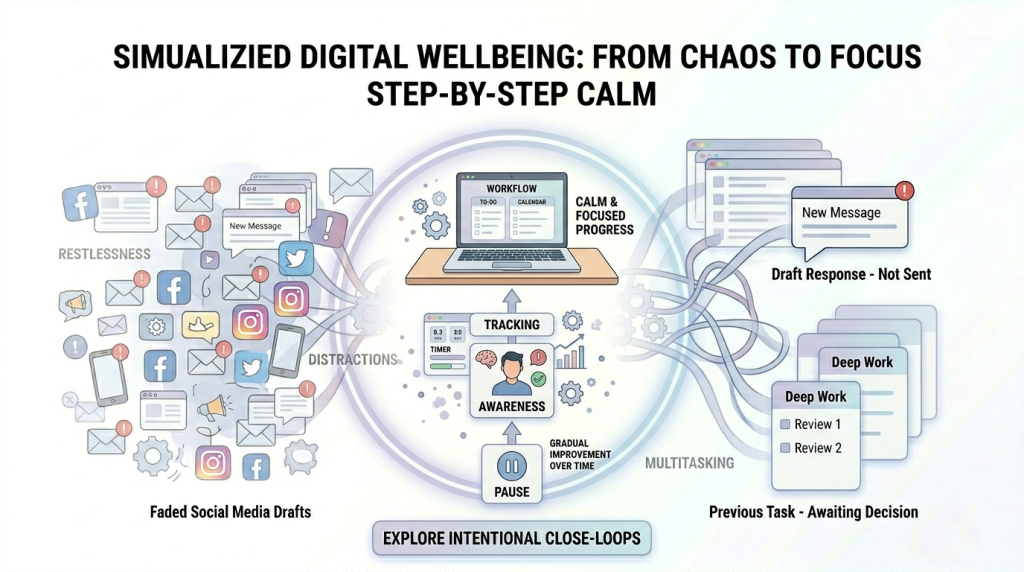
Tracking your distraction patterns- even loosely- is more powerful than any blocker. ComfortZoneCheckin’s approach is built on this: detecting the difference between active research and passive scrolling, and surfacing that information at the right moment. Not to punish, but to make the invisible visible.
Gentle Nudges Beat Hard Blocks
There’s a meaningful difference between being cut off and being reminded. A hard block creates friction and resistance, sometimes even a rebellious urge to find a workaround. A well-timed, non-judgmental nudge re-engages your prefrontal cortex without the shame spiral.
The goal isn’t to visit a distraction site again. It’s to stop doing it on autopilot. That single moment of awareness, wait, have I been here for 20 minutes?, is often enough to break the loop and redirect toward something real.
Small Shifts That Compound Over Time
You don’t need a productivity overhaul. You need a few small changes that work with how your brain actually operates.
The Power of a Mindful Pause
Before you open a new tab or pick up your phone, try inserting a half-second of intention: Why am I doing this? Not as a moral interrogation, just as a genuine check. Most of the time, there’s no reason. You were on autopilot.
That pause is the whole game. It doesn’t block anything. It doesn’t require willpower. It just gives your conscious brain a chance to catch up with your habit brain. Over time, those micro-moments of awareness accumulate into genuinely different patterns.
Tracking Your Patterns Without Judgment
The most useful data you can collect isn’t your to-do list, it’s your distraction map. When do you drift most? What were you working on right before? What did you open instead?
You don’t need a fancy app for this. A simple note at the end of the day, “lost 40 minutes between 2–3 pm, right after the difficult email,” tells you more than any time-tracking software. It shows you where your environment or workflow is creating the conditions for distraction, so you can adjust them at the source.
How to start fixing distraction today, in order:
1. Identify your biggest distraction trigger (boredom, task anxiety, notifications, or habit autopilot); this determines which fix to try first.
2. Design one piece of physical friction: move your phone to another room, log out of your highest-drain app, or delete it from your home screen.
3. Before your next deep work session, close every unrelated tab and finish or park any open mental loops from previous tasks.
4. Insert one intentional pause before opening any app for the next week, just a half-second check of “why am I doing this?”
5. At the end of each day, note when you lost focus and what you were doing right before. One week of this data tells you more than any productivity system.
Expert tip: Don’t try all five at once. Pick the single step that matches your biggest gap and hold it for two weeks before adding another.
Conclusion
If you’re still distracted after trying everything, the answer isn’t more willpower or stricter rules. It’s a better understanding of what’s actually happening, and a system that works with your brain instead of against it.
Distraction isn’t a character flaw. As the team at ComfortZoneCheckin puts it, it’s a design challenge. And like any design challenge, it responds well to the right tools applied at the right moment.
Start small. Pick one thing from this post, maybe it’s noticing your scroll patterns, or designing a little friction into your phone use, or learning what attention residue is actually costing you. Small, consistent choices compound. And you don’t have to fix your focus all at once to start feeling the difference.
If you’re ready to stop fighting distraction and start building awareness around it, ComfortZoneCheckin was built for exactly that. Give it a look, and give yourself some credit for still showing up and trying.
And if you take nothing else from this, the fact that you’re still looking for answers means you haven’t given up on yourself. That’s nothing. Most people who successfully rebuild their focus don’t do it in one dramatic shift; they do it by refusing to accept distraction as permanent, and by making one small, consistent change at a time. You’re already doing the first part.
Frequently Asked Questions
Notifications are only one layer of distraction. The deeper issue is often internal, unfinished mental loops, anxiety about a hard task, or habitual autopilot browsing. Removing notifications reduces external triggers, but doesn’t address the emotional and cognitive patterns underneath.
Very normal, and increasingly common. The combination of always-on digital environments, context-switching between multiple tools, and chronically high stress creates conditions that make deep focus genuinely difficult. It’s a systemic problem, not a personal one.
Attention residue is the mental lingering that happens when you switch tasks before fully resolving the previous one. Your brain keeps a background process running on the unfinished task, which quietly drains the focus you’re trying to apply to the new one. It’s one of the most underappreciated causes of persistent distraction.
For some people, yes, especially as a starting point. They help break large tasks into smaller chunks and create built-in permission to take breaks. But they don’t address why you drift in the first place, and they rely on you starting the timer in the first place, which can be its own hurdle.
There’s no fixed timeline, but most people notice meaningful improvement within 2–4 weeks of consistent, low-friction habit changes. The key is consistency over intensity; small daily improvements beat occasional willpower sprints every time.