
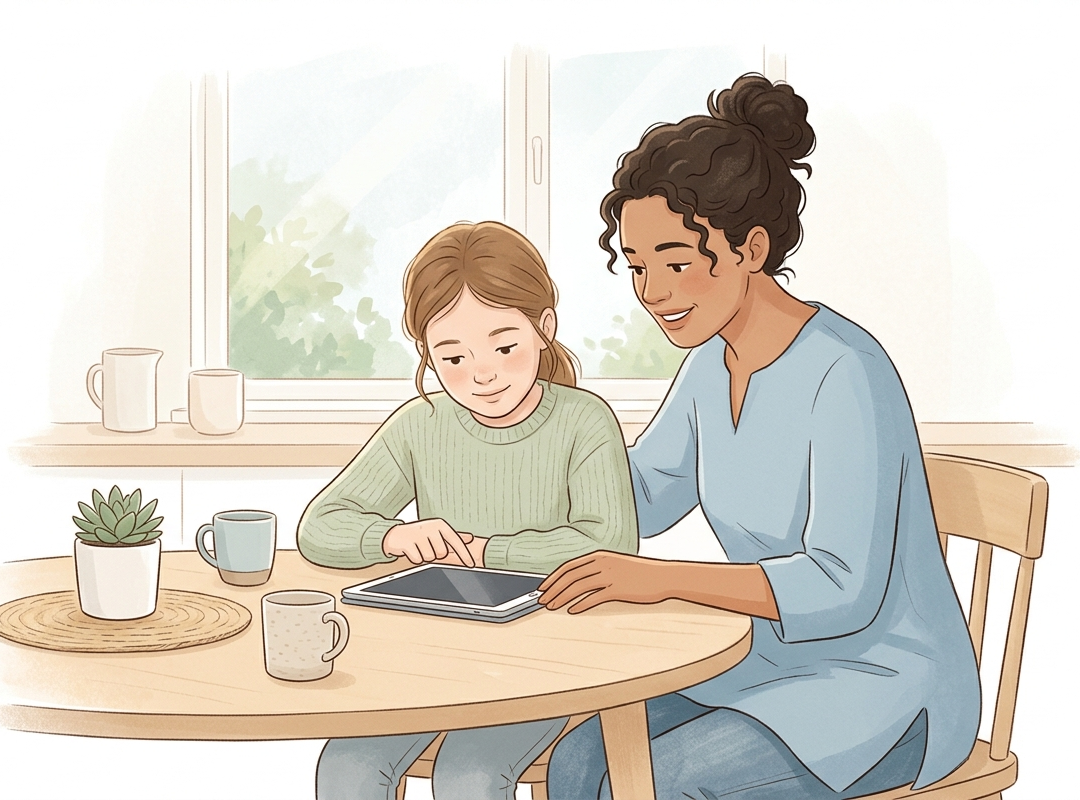
If you have ever taken a phone away from your child and immediately felt guilty about it, you are not alone. Parents today carry a near-constant low-level anxiety about screen time, and much of the public conversation has done little to help. But the research tells a more nuanced story than the headlines suggest. Screen time is not a monolith. What your child does on a screen, with whom, and for how long matters far more than the presence of a device itself. The right kind of screen time builds real, lasting skills. Here are ten evidence-backed reasons why screen time is good, when you know what to look for.
Quick Takeaways
- Screen time builds the digital literacy kids will need for school and work
- Educational and creative screen use delivers far more benefit than passive scrolling
- Co-viewing with a parent amplifies almost every benefit on this list
- The right kind of gaming develops genuine problem-solving and social skills
- The goal is intentional, conscious use, not zero screens
1. It Builds Digital Literacy: The Skill Employers Will Expect
Digital literacy is not a bonus skill anymore. It is a baseline expectation in almost every academic and professional setting your child will enter. When children learn to navigate platforms, check whether online sources are credible, and use technology to create as well as consume, they are building skills that pay off throughout school and beyond. A 2025 study examining over 2,500 students in grades 8 through 11 found that digital skills mediate the relationship between online media use and academic achievement. In other words, the students who developed real digital skills from their screen time performed better academically. That is not an argument for unlimited screen time. It is an argument for making sure some of it counts.

2. Educational Screen Time Supports Real Learning
Not all screen time is passive, and not all of it is entertainment. Educational screen time (high-quality apps, age-appropriate programming, interactive lessons) has measurable cognitive benefits. The Canadian Paediatric Society found that quality educational television and programming from around age two provides an additional meaningful route to language and literacy development. Apps built around storytelling, maths, or coding can sharpen memory and keep kids engaged in subjects that might feel dry on paper. Educational screen time is the category most consistently linked to positive child development outcomes across the research literature. (Common Sense Media)
3. It Keeps Kids Connected to the People They Love
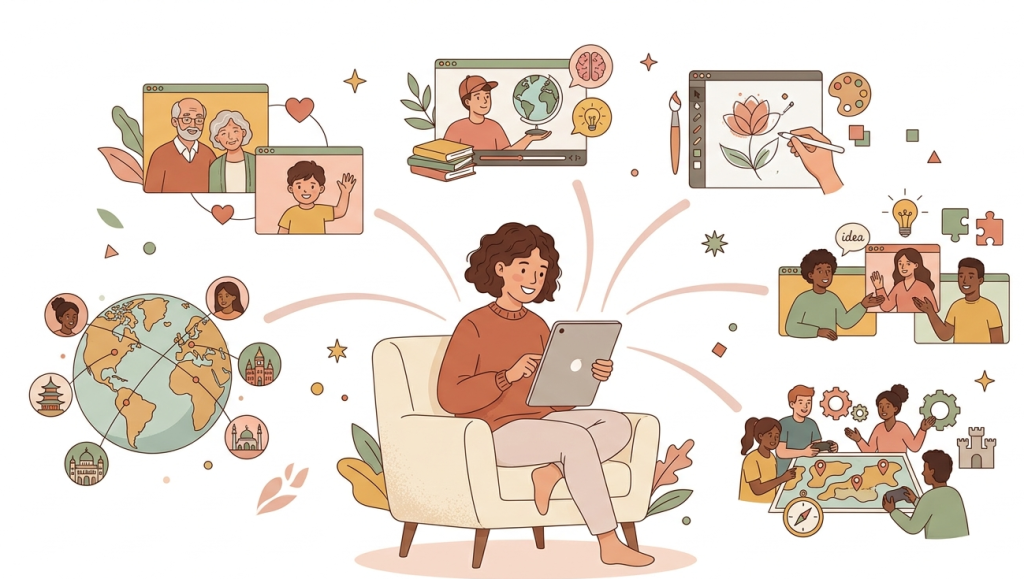
A grandparent in another country. A best friend who moved away last year. A cousin three time zones behind. Screens make these relationships possible in a way no previous generation of children could access. Video calls are not a lesser substitute for connection. They are connected. The American Academy of Pediatrics specifically endorses video calls as a beneficial form of screen use even for very young children, because the relational value is real. Research from Oxford University found that moderate screen time is associated with better wellbeing in children, and social screen time, the kind that maintains relationships, is a meaningful part of that picture.
4. The Right Kind of Gaming Develops Cognitive Skills
Gaming has a complicated reputation, but the research is more generous than the headlines. The key word is “the right kind.” Strategy, puzzle, and cooperative multiplayer games are consistently linked to better problem-solving, sharper attention, and stronger working memory. A 2025 study published in Frontiers found that playing cooperative games significantly increased prosocial behaviours like sharing in young children, suggesting that game design itself can be a vehicle for social and emotional development. When children game cooperatively, they practise real-time communication, coordination, and conflict resolution. These are not trivial skills.
5. Screens Are a Canvas for Creativity
For a child who wants to make music, animate a short film, design a game, code an interactive story, or teach themselves digital art, the internet is an extraordinary resource. Digital creative tools give children access to professional-grade mediums without expensive lessons or equipment. Screen time in this form, what researchers classify as “content creation,” is among the most developmentally rich categories of screen use. Studies have found that children who use screens to produce rather than only consume develop stronger creative thinking, digital skills, and a sense of competence and accomplishment. Screen time creativity is a genuine developmental benefit, not a consolation prize.
6. It Opens Doors to Communities Kids Can’t Find Locally
One of the least discussed benefits of screen time is what it does for children with niche interests. A child passionate about competitive chess, historical linguistics, mechanical engineering, or birdwatching no longer has to feel isolated in that passion. Online communities, interest-based forums, and YouTube channels run by genuine enthusiasts connect young people with mentors, peers, and resources that simply do not exist in most neighbourhoods. Internet Matters has noted that technology specifically removes physical and social barriers to connection, and this matters most for children who find it difficult to make friends locally, or whose interests fall outside what their immediate community can offer.
7. Screen Time Prepares Kids for How School and Work Actually Operate
Modern education already requires screens. Research papers, collaborative documents, virtual presentations, coding classes: learning is increasingly digital, and that trend is not slowing down. Familiarity with these tools does not hinder academic performance; it supports it. Children who are confident and competent with technology are better prepared for the environments they will actually encounter. The 2025 Tandfonline study found that digital skills built partly through leisure screen use had a measurable compensatory effect on academic performance, and students who developed real digital fluency were more capable in assessed academic tasks.
8. It Supports Emotional Wellbeing and Healthy Stress Relief
Entertainment is a legitimate human need, and screens deliver it effectively. Watching a favourite show, playing a relaxing game, or listening to music after a demanding school day serves a genuine function: it helps children decompress, regulate emotions, and reset. Clinical psychologist Emily Edlynn notes that “if we look at screen time broadly as one form of leisure and social connection, using any form of screen time in these ways can be beneficial and enrich children’s lives.” The Oxford research supports this: moderate, intentional screen time is associated with better emotional wellbeing in children, not worse. The risk is not screen time per se. It is excessive, purposeless, late-night screen time. (If late-night screen use is a concern, this guide on what too much screen time does to the body is worth a read.) Used wisely, it is a legitimate tool for screen time mental health support.
9. Screens Give Kids Access to Information and Diverse Perspectives
A child with a question today has access to more information than any library in history could hold. That access, when paired with guidance on how to evaluate what they find, is genuinely empowering. Children can research school topics, explore cultures and histories beyond their own, and find answers to questions they might not feel comfortable asking an adult. Quality documentary content and educational videos, in particular, can support social skill development and expand children’s sense of the world. The Canadian Paediatric Society found that quality digital content can enhance social skills in children from age two onwards, partly because of the breadth of experience and perspective it makes accessible.
10. Managed Screen Time Teaches Kids to Self-Regulate
Perhaps the most underrated benefit on this list is what happens when parents treat screen time as a shared, managed practice rather than a battle. When children help set their own screen time rules and practise putting the device down when they have had enough, they are building self-regulation skills that carry into every other part of their lives. The research is consistent: parental involvement and co-viewing transform screen time outcomes. Tools like ComfortZoneCheckin are built around exactly this principle. The AAP’s Family Media Plan framework reflects this, encouraging families to set personalised, consistent limits together. A child who learns healthy screen habits early is not just a better screen user. They are better at managing their impulses and attention across every area of life. A common working target for school-age children is under two hours of recreational screen time on school days, but what matters more than the number is what the screen time consists of and what it is replacing.
The conversation about screen time has always been less about devices and more about habits. No screen is inherently good or bad, and no daily hour count makes a child healthy or unhealthy. What matters is whether the screen time your child has is building something: skills, relationships, creativity, competence, or just filling time. When it is building something, there is nothing to feel guilty about.
Frequently Asked Questions
The American Academy of Pediatrics no longer sets a universal daily hour limit for children over six. Instead, they recommend that families create a personalised Family Media Plan that ensures screens do not crowd out sleep, physical activity, homework, or face-to-face time.
Research consistently identifies educational screen time, creative content creation, and interactive communication as the most beneficial categories. Passive consumption (scrolling feeds, watching algorithmically recommended videos) delivers the least developmental benefit and is most associated with negative outcomes when excessive. The screen time benefits for kids are most pronounced when children are active, engaged, and ideally in conversation with a parent or peer about what they are seeing or doing.
Co-viewing is one of the most effective things you can do. Watching or playing alongside your child and discussing the content dramatically improves outcomes. Beyond that: choose apps and platforms with clear educational goals, involve children in selecting their screen time, and frame device use around skills (“let’s find a coding game” or “show me what you made”) rather than just duration.