You sat down to work. You didn’t open social media. Your phone is face down. And yet, ten minutes in, your mind is elsewhere.
Most focus advice targets the obvious culprits: notifications, apps, and noisy environments. Silence those things, and clarity should follow. Except it doesn’t. Not consistently. And that’s because the most damaging triggers for lost focus are rarely the ones you can see on your screen.
This post is about the hidden ones, the internal, physiological, and environmental triggers that quietly erode your concentration without ever announcing themselves. Once you know what they are, you can actually do something about them.
Quick Takeaways
- Distraction isn’t always external, internal triggers like unfinished tasks and mental clutter are major hidden culprits
- The Zeigarnik Effect keeps incomplete tasks actively running in your brain, draining focus even between work sessions
- Physical factors like dehydration, poor sleep, and blood sugar dips impair concentration in ways that feel like laziness
- Visual and digital clutter force your brain to process competing stimuli, consuming executive function you need for real work
- Awareness of your specific triggers is more powerful than any generic productivity rule
When people think about why they lose focus, they usually land on the same list: social media, notifications, a noisy environment, and a boring task. These are real. But they’re also well-documented and widely managed; most people reading this have already tried the obvious fixes.
Hidden triggers are different. They operate below conscious awareness. Neuroscience research shows that the brain’s attention network, involving the prefrontal cortex, parietal cortex, and thalamus, is constantly filtering competing inputs, both external and internal. When something consumes that filtering capacity, focus degrades. You don’t notice the cause. You just notice that you can’t seem to think clearly.
Understanding your personal hidden triggers is the first step toward fixing a focus problem that doesn’t respond to standard advice.
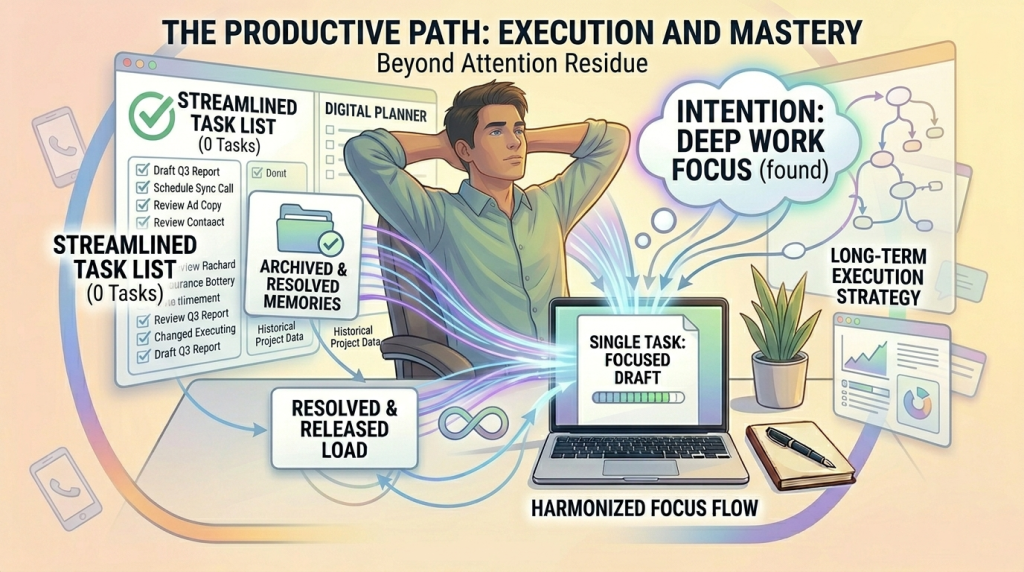
This one is responsible for more lost concentration than most people realize, and it operates entirely inside your head.
What Open Loops Are
An open loop is any unfinished task, unresolved commitment, or incomplete thought that your brain is still tracking. The unanswered email. The decision you’ve been postponing. The conversation you haven’t had yet. These aren’t just items on a to-do list; they’re active processes in your working memory, silently competing for cognitive resources you’re trying to direct elsewhere.
The Psychology Behind It
Psychologist Bluma Zeigarnik discovered that people consistently remember incomplete tasks more vividly than completed ones. The brain keeps an open loop running until it’s resolved, a mechanism that evolved to help us follow through, but in a world of perpetual incompletion, it becomes a liability.
Research by Dr Roy Baumeister and colleagues found that mental energy is finite. The more open loops you’re carrying — each one small — the more you deplete the cognitive resources you need for focus. One documented case tracked focus session lengths before and after deliberately reducing open loops from 27 to 4 over two weeks. The average uninterrupted focus session went from 38 minutes to significantly longer, with a measurable reduction in nightly mental replay.
What to Do
The single most effective tool is a brain dump: at the start of a work session, write down every unresolved task and thought circling in your mind. Research shows the brain only releases an item from working memory when it trusts that it’s been captured somewhere reliable. Getting it onto paper signals to your brain that it’s safe to let go — and that mental bandwidth becomes available for actual work.
These are so basic that they get dismissed. But the evidence is consistent and significant: your body’s physical state directly governs how well your prefrontal cortex functions, and your prefrontal cortex is what maintains sustained attention.
Sleep Debt Is a Focus Tax
Research consistently shows that sleep deprivation disrupts the central nervous system’s ability to process and transmit information reliably. After even one night of reduced sleep, working memory declines, reaction time slows, and the ability to filter irrelevant information, the core mechanism of attention, is measurably impaired. And because sleep-deprived people tend to underestimate how impaired they are, the drifting focus often gets blamed on a boring task or a lack of motivation rather than the actual cause.
If your focus feels inconsistently unreliable, sharp some days, foggy on others, sleep quality is one of the first variables to examine honestly.
Dehydration and Blood Sugar Dips
Even mild dehydration impairs cognitive performance. Research on attention and hydration has found that roughly 40% of people are degrading their focus through a cause that’s simply fixed. A 1–2% drop in body water levels, less than you’d notice as thirst, is sufficient to reduce concentration and short-term memory.
Blood sugar plays a similar role. The brain runs almost entirely on glucose, and sharp dips in blood sugar mid-morning or mid-afternoon produce exactly the fuzzy, ” can’t start anything ” feeling that gets misread as lack of motivation. The timing of when you eat, and what you eat, can meaningfully affect the quality of your focus windows during the day.
What to Do
Before reaching for another productivity technique, run through a physical state checklist: How much sleep did you get? Have you had water in the last few hours? When did you last eat, and was it high in refined carbohydrates that would cause a glucose spike and crash?
These are unglamorous interventions. They’re also some of the highest-leverage ones available.
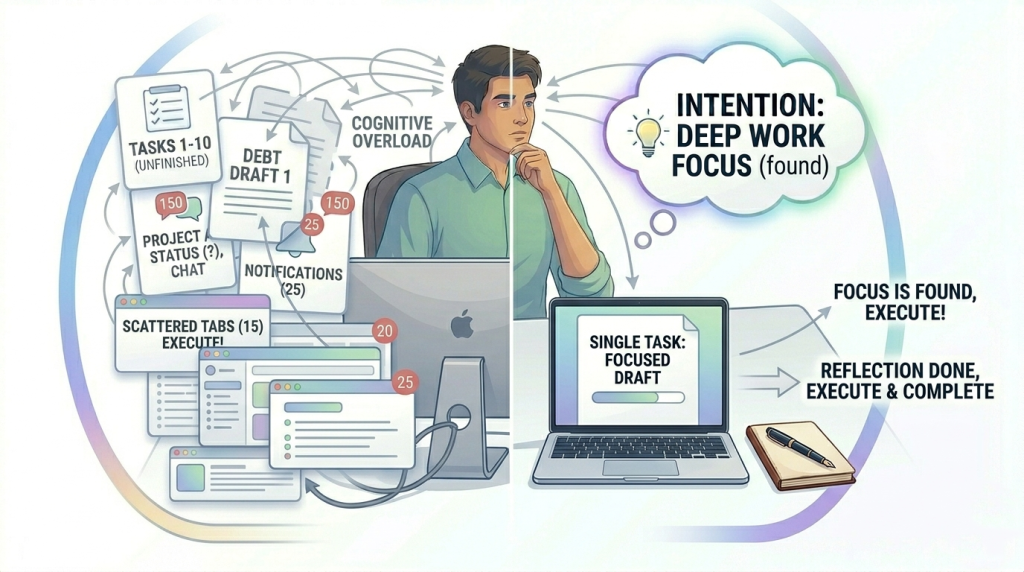
Your brain scans your environment constantly, including peripherally, and including when you’re “not looking.” And research using functional MRI scans has shown that cluttered environments activate areas of the brain associated with conflict monitoring and error detection, even when you’re not consciously aware of the mess around you.
The Cognitive Load of Visual Noise
A landmark 2011 Princeton study found that physical clutter directly competes for attention, reducing performance and increasing stress. What this means practically: a cluttered desk, an overflowing inbox, or a browser with 30 open tabs isn’t just aesthetically overwhelming; it’s consuming executive function that should be directed at your work.
Each open tab is a micro-decision waiting to happen. Each notification badge is a Zeigarnik trigger, a small open loop your brain feels compelled to track. The accumulation of these is what creates the feeling of being simultaneously busy and unable to start anything.
Digital Clutter Is Just as Real
Physical clutter has a digital equivalent. Research on passive scrolling and app overload both point to the same underlying mechanism: competing stimuli drain the filtering capacity your brain needs for focused work. When every surface, physical and digital, demands attention, none of your actual work gets it.
What to Do
The fix is intentional reduction: close tabs you aren’t using right now. Clear your desk before a deep work session. Disable notification badges on apps that don’t require real-time responses. These take minutes and produce results you can feel within the same session. Research confirms that even five minutes of closing unused windows and silencing notifications measurably reduces perceived cognitive load.
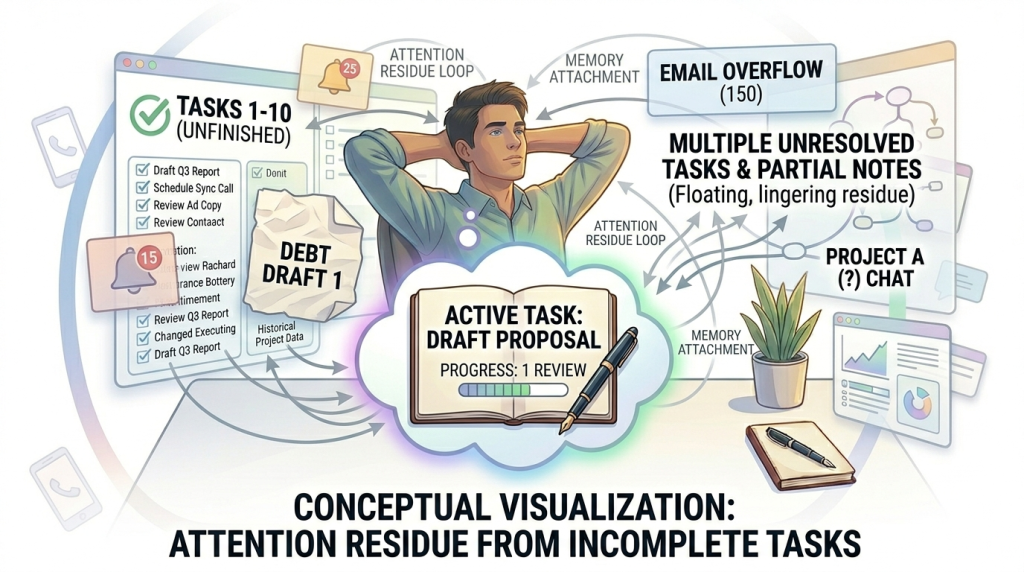
Most people know that switching tasks hurts focus. Fewer people understand how long the damage lasts — or that it starts before the switch even happens.
Attention Residue: The Cost Nobody Accounts For
Dr Sophie Leroy’s research on attention residue showed that when you move from one task to another, part of your cognitive attention stays with the previous task — especially if it was left incomplete. You’re physically present on the new task, but mentally still partly on the old one. Performance suffers on both.
Gloria Mark’s research at UC Irvine found that knowledge workers switch tasks every three minutes on average, and that full refocus after a disruption takes over 20 minutes. If you’re switching tasks even four or five times in a morning, you’ve already lost hours of genuine focus time, not to distraction, but to recovery from transition.
The Meeting Hangover
A specific and underappreciated version of this is what happens after meetings. A 45-minute discussion — especially a difficult one — leaves significant attention residue. Research on cognitive load confirms that context switching between meetings and deep work forces the brain to refocus, depleting the executive function needed for creative or analytical thinking. Starting a demanding project immediately after back-to-back meetings is biologically disadvantaged.
What to Do
Build short transition rituals between different types of work. A two-minute note — capturing what you just finished, what’s still open, and what the next task requires — helps your brain close the previous loop before the new one begins. Scheduling deep work sessions away from dense meeting blocks allows the residue to clear.
This is the trigger that’s hardest to name but often the most powerful. When you lose focus mid-task for no apparent reason, there’s a reasonable chance the task itself is generating a low-level emotional response that your conscious mind hasn’t registered yet.
Avoidance in Disguise
Research on procrastination and emotional regulation consistently shows that tasks which trigger anxiety, boredom, uncertainty, or fear of failure produce avoidance — even when you’re not consciously aware of feeling any of those things. The distraction arrives first. The emotion driving it surfaces later, if at all.
This is why you can lose focus on a task you genuinely care about. The caring is real, but so is the subtle fear attached to it. And because the emotional brain can override the rational one, particularly under conditions of fatigue or stress, the avoidance often wins before you’ve had a chance to notice it.
Low-Level Anxiety as Background Noise
Separate from task-specific avoidance, chronic background anxiety, and the general low-level hum of unresolved stress, it depletes the attentional resources you need for sustained focus. The American Psychological Association notes that chronic low-level stressors accumulate and impair concentration even when each individual stressor appears minor. Open loops, unresolved conflicts, and pending decisions — each contributes to the ambient noise that competes with the work in front of you.
What to Do
The first move is simply noticing. Before labelling a focus failure as laziness or distraction, pause and ask: What does this task actually feel like? Is there anything uncomfortable attached to it — uncertainty, exposure, high stakes? Naming the emotion doesn’t resolve it, but it interrupts the automatic avoidance cycle. And it often reveals a more targeted intervention than a productivity technique ever would.
Rather than trying to fix everything at once, it helps to identify which triggers are most active for you personally. Here’s a quick diagnostic:
| If you lose focus most… | The likely hidden trigger is… | Start here |
|---|---|---|
| In the middle of a task, with no external distraction | Open loops / Zeigarnik Effect | Morning brain dump |
| On days after poor sleep or by late afternoon | Physical state (sleep, blood sugar, hydration) | Sleep audit + eating schedule |
| In cluttered spaces or with many tabs open | Visual / digital clutter | Pre-session environmental reset |
| Right after meetings or task switches | Attention residue / context switching | Transition rituals |
| On tasks that feel big or uncertain | Emotional avoidance | Name the feeling; shrink the first step |
Conclusion
Losing focus too often isn’t usually about lacking discipline. It’s about operating in conditions where focus is structurally difficult — conditions you may not have thought to examine because they don’t look like distraction.
Open loops running in the background. A body that’s slightly depleted. A cluttered environment taxing your executive function. A meeting-heavy morning leaving no cognitive room for the afternoon’s work. An emotional undercurrent you haven’t named yet. These are the real focus killers for most people — and none of them show up on a standard productivity checklist.
The good news is that once you know your triggers, they’re all workable. And ComfortZoneCheckin is a practical first step: it detects when you’ve drifted into passive scrolling and surfaces a quiet, non-judgmental nudge to help you recognize the pattern in real time. Not as a punishment — as awareness. Because the moment you can see the trigger, you can choose a different response.