
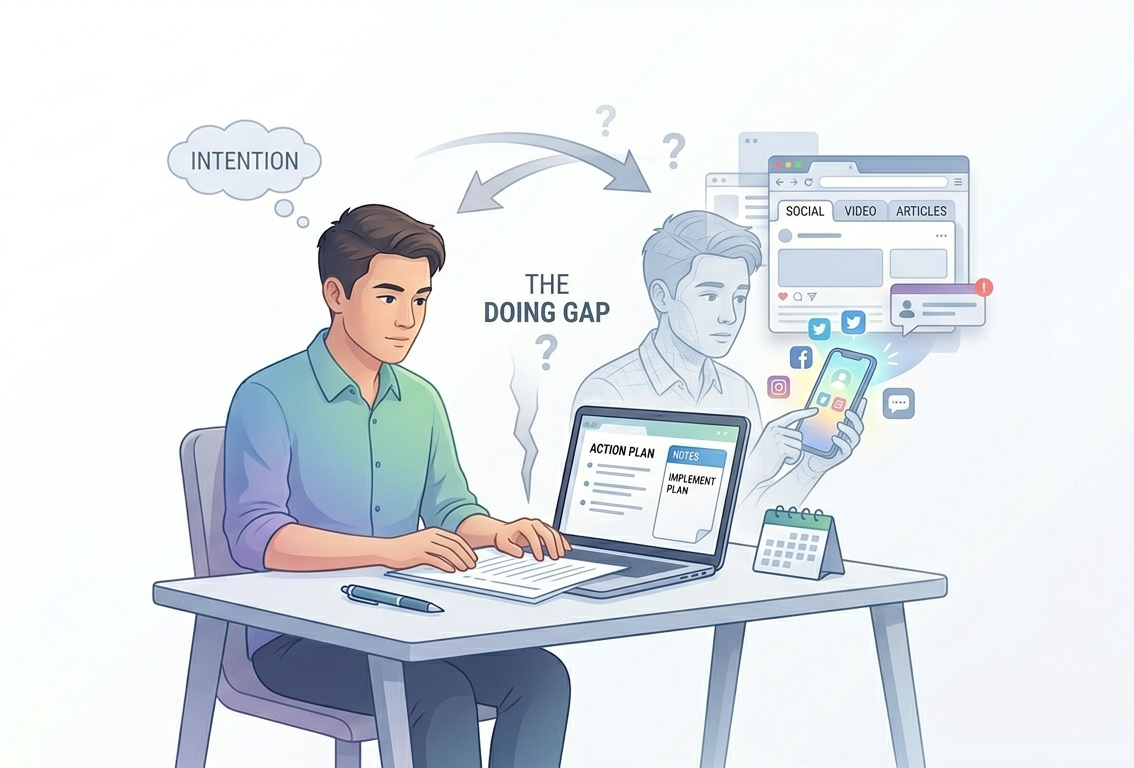
You know you should start the project. You know scrolling at 11 pm is wrecking your sleep. You know the email has been sitting there for three days. And yet, you still don’t do it.
This isn’t ignorance. It isn’t laziness. It’s one of the most quietly frustrating experiences a person can have: knowing exactly what needs to happen and still not making it happen. Psychologists even have a name for it: the intention-action gap. And understanding it might be the most important thing you do for your productivity this year.
This post breaks down why knowledge alone rarely drives action, what’s actually getting in the way, and what small, practical shifts can finally start closing that gap.
Quick Takeaways
- Knowing what to do and doing it are two entirely separate cognitive events – one doesn’t automatically lead to the other
- Only 28% of goals are ever followed by any action at all; intention alone is a weak predictor of behavior
- Procrastination is not a time-management problem – it’s an emotional regulation problem
- The brain prioritizes short-term emotional comfort over long-term outcomes by design
- Closing the knowing-doing gap requires reducing friction and building awareness, not more willpower
The Knowing-Doing Gap Is Real – and It’s Not Your Fault
There’s a concept in psychology and organizational research called the knowing-doing gap, first explored by Jeffrey Pfeffer: the disparity between what we know we should do and what we actually do. It’s not about ignorance. It’s not about lacking the ability. It’s the strange, maddening space between intention and execution.
What makes it so frustrating is that it feels like a personal failing. If you know better, you should do better. But that’s not how the brain actually works.
Why Intention Is a Weak Predictor of Behavior
Research in behavioral science has found that only 28% of goals are ever followed by any action whatsoever. That means roughly two-thirds of everything we intend to do never moves past the “I want to do this” stage. Even more sobering: studies suggest that intention alone predicts only 30–40% of the variation in actual behavior. We’re not as rational as we assume. Wanting something, even strongly, does not reliably produce doing something.
The Stages Between Knowing and Doing
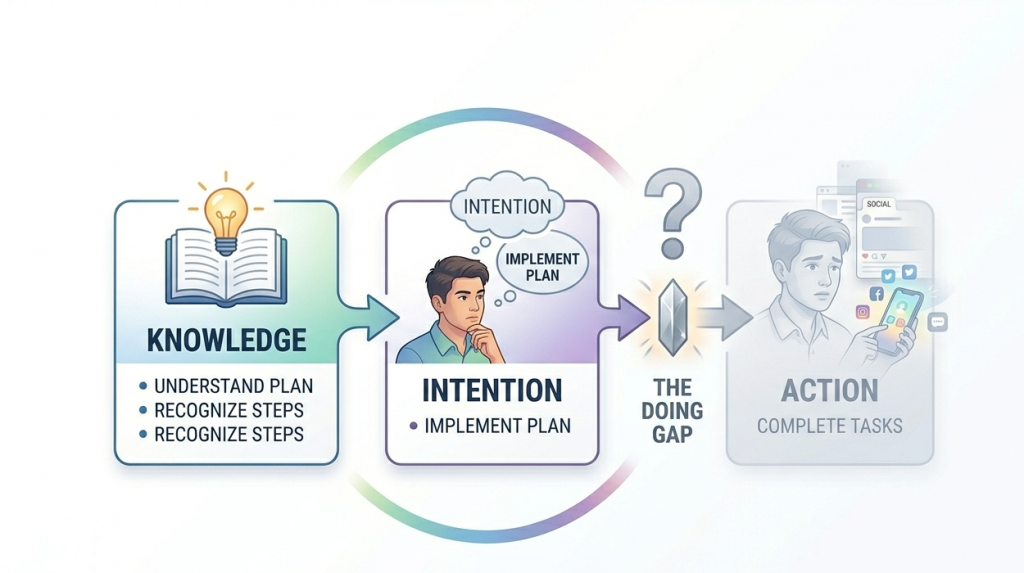
One useful way to understand why the gap exists is to look at what actually has to happen for knowledge to become action. Behavioral researchers describe a chain of stages: acquiring knowledge, forming values around it, translating those values into intentions, and then converting intentions into actual behavior. Each stage is a step in itself, and any one of them can break down. By the time you’ve moved through all of them, you’ve expended real cognitive effort, and that’s before doing the task itself.
It’s Not a Willpower Problem. It’s an Emotional One.
Here’s the insight that changes everything: procrastination is primarily an emotional regulation problem, not a time-management problem. You’re not putting things off because you’re disorganized. You’re putting them off because starting the task produces uncomfortable feelings, and your brain has learned to avoid those feelings by delaying.
What Your Brain Is Actually Doing
When you face a task that feels complex, uncertain, or high-stakes, the brain’s limbic system, the emotional hub, responds as if it’s a mild threat. Neuroscience research shows that when this happens, the amygdala activates, steering you toward immediate relief, checking your phone, opening a browser, or doing something easier. The prefrontal cortex tries to override this impulse with reason. But under fatigue, stress, or distraction, the emotional system wins. Nearly every time.
Researchers Fuschia Sirois and Timothy Pychyl found that procrastination “involves the primacy of short-term mood repair over the longer-term pursuit of intended actions.” Translated: you’re not avoiding the task. You’re avoiding the feeling the task produces. That’s a much harder thing to fix with a to-do list or a productivity app.
Temporal Discounting: Why Future Goals Feel Far Away
There’s another layer to this. The brain processes future goals abstractly, almost as if they belong to a different person. When the deadline is next month, the emotional urgency is weak. The consequences don’t feel real yet. This is known as temporal discounting; the brain naturally undervalues future rewards relative to immediate ones. So even when you genuinely want to finish the project, the Netflix queue feels more real, more now, and more satisfying to the brain, making the moment-to-moment call.
The Common Reasons You Know But Still Don’t Do
Understanding the general mechanism is useful. But it helps to recognize the specific patterns that show up most often. Here’s a breakdown of the most common knowing-doing blockers:
| Blocker | What It Looks Like | What’s Really Happening |
|---|---|---|
| Emotional avoidance | Delaying a task that feels scary, boring, or overwhelming | Brain treats discomfort as a threat and routes away from it |
| Temporal discounting | “I’ll feel more motivated later.” | Future consequences feel distant and unreal; present comfort wins |
| Decision fatigue | Knowing what to do but not knowing where to start | Too many choices have depleted your cognitive resources |
| Perfectionism | Waiting until conditions are right | Fear of failure or imperfect output activates avoidance |
| Optimism bias | The brain treats discomfort as a threat and routes away from it | Overestimating future motivation; underestimating inertia |
| Attention residue | Starting something else instead | Unfinished mental loops from prior tasks compete for focus |
Why More Information Doesn’t Help
If knowing isn’t the problem, then more information isn’t the solution. Yet this is exactly what most of us reach for when we’re stuck — another article, another book, another podcast. It feels productive. It’s often avoidance in disguise.
The Information-Action Trap
One pattern that shows up repeatedly with chronic knowing-doing gaps is that people use knowledge-gathering as a substitute for action. Reading about the task feels like progress. Planning the task feels like movement. But neither is the thing itself. The more knowledge accumulates without action, the heavier the backlog of intention becomes — and the harder it is to start.
This is also why most of the standard productivity advice fails for this problem. Knowing the Pomodoro Technique exists doesn’t make you use it. Understanding time-blocking doesn’t make you protect your calendar. Knowledge and execution are related, but they are not the same thing, and one does not automatically produce the other.
What Does the Inspiration Loop Look Like?
If you’re a creator, freelancer, or knowledge worker, you’ve probably experienced what ComfortZoneCheckin calls the Inspiration Loop: hours spent watching tutorials, reading references, or consuming content in the name of “research”, without ever starting the actual work. It feels like preparation. But our use-cases page names this pattern directly: passive consumption dressed up as active production. Recognizing it is the first step out of it.
What Actually Closes the Knowing-Doing Gap?
Make the First Step Smaller Than You Think Is Necessary
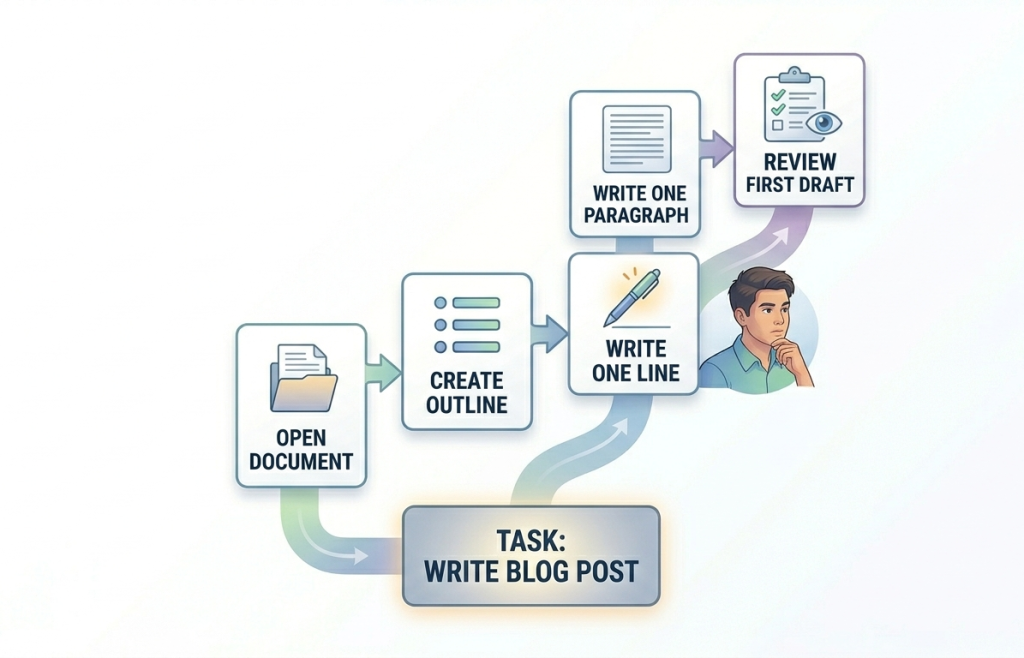
The starting point matters more than almost anything else. Behavioral research on task initiation is consistent: make the entry point so small that not doing it would take more energy than doing it. “Write the report” doesn’t move. “Open the document and type the first sentence.” does.
This isn’t a trick. It’s neurologically sound. Starting reduces the perceived threat of the task. Once the emotional avoidance response diminishes, momentum builds naturally. The Five-Minute Rule from cognitive behavioral therapy operates on exactly this principle: commit to five minutes only, with full permission to stop. Most people don’t stop.
Use Implementation Intentions, Not Just Goals
Goals describe outcomes. Implementation intentions describe the exact moment and trigger for action. Research shows that replacing “I’ll work on this today” with “When I sit down with my morning coffee, I’ll open the document and write the first paragraph” dramatically increases follow-through. The specificity isn’t perfectionism; it offloads the decision from willpower to habit.
This is one of the more underused tools in the gap-closing toolkit. If you’ve been setting intentions and not following through, there’s a good chance your intention is still too vague to activate the right behavior at the right moment.
Reduce Friction on the Right Side
One of the most effective principles for closing the knowing-doing gap isn’t adding more motivation; it’s making the right action easier than the wrong one. Lay your running shoes out the night before. Keep the document open when you close your laptop. Pre-load the task so that starting requires less energy than not starting.
This is the same principle at the heart of how ComfortZoneCheckin works: rather than hard-blocking distractions through willpower, it surfaces a gentle nudge the moment passive scrolling is detected — a low-friction cue that re-engages intentional thinking at precisely the right moment. The nudge doesn’t demand anything. It just asks: is this what you meant to do?
Build Awareness Before You Try to Build Discipline
Most approaches to the knowing-doing gap start with discipline — commit harder, schedule better, hold yourself more accountable. But research increasingly points to awareness as the prerequisite. Before you can change a pattern, you have to see it. Don’t judge it. Do not punish it. Just notice it clearly enough to make a different choice.
Ask yourself: What emotion comes up when I think about this task? Is it fear, boredom, or overwhelm? The moment you can name the emotional barrier, it loses some of its automatic power over your behavior. This is also why tracking distraction patterns, when you drift, what triggers it, and what you open instead, is more useful than most productivity hacks. Understanding your specific patterns gives you something to actually work with.
Conclusion
The gap between knowing and doing isn’t a character flaw. It’s a design problem, one that shows up in how tasks are framed, how environments are set up, and how well your system supports follow-through in the moments when motivation is low and distraction is high.
You don’t need more information. You need a shorter first step, a cleaner trigger, and a moment of awareness at the right time. Small, structural changes that work with your brain, not against it, are what finally close the gap.
If you’re ready to build that kind of awareness into your daily workflow, ComfortZoneCheckin is designed for exactly that: a quiet, non-judgmental nudge that helps you notice when you’ve drifted — so you can choose differently, one moment at a time.