

Most students believe the problem is not studying enough. The research says something different.
A 2024 multilevel analysis of 11,237 students across 95 courses found that digital distractions during study sessions consistently hurt academic performance, regardless of total hours logged. A separate PISA survey of 15-year-olds across 30 countries found that two-thirds of students reported being regularly distracted by their own digital devices during class. Fifty-four percent said they were also distracted by watching other students use theirs.
The pattern is consistent: the quantity of study time does not predict outcomes. It is the quality of attention during that time.
This matters because most advice about studying focuses on tactics, scheduling apps, color-coded notes, study playlists, and the like, while ignoring the underlying neuroscience of how attention and memory actually work. The habits below are grounded in that science. Each one addresses a specific mechanism in how the brain learns, focuses, and retains information.
Common distractions students face today
The single biggest structural change in studying over the past decade is not academic pressure. It is the smartphone. Students now carry a variable-reward notification machine with them into every study session. Research reviewed by ScienceDirect in 2025 confirmed a statistically significant negative correlation between daily smartphone usage time and academic performance, mediated specifically by poor attention regulation.
The good news: attention is trainable. The environment is designable. The habits below work precisely because they work with how your brain is built, not against it.
Top 10 Study and Focus Habits
1. Set Clear Study Goals
Setting a vague intention to “study” produces vague results. Your brain needs specificity to allocate attention effectively.
Decide what topics or tasks you will complete
Before sitting down, write exactly what you will complete in this session. Not “study for biology” but “finish chapter 4 summary notes and review the diagram on cell division.” That level of specificity activates the prefrontal cortex’s planning circuits, which are the same circuits responsible for sustaining focus.
Break big assignments into smaller steps
Large, undefined tasks are the single biggest trigger for procrastination. When the brain perceives a task as ambiguous or overwhelming, it defaults to avoidance. Breaking a 10-page paper into five concrete sub-tasks, for example, find three sources, write the introduction, draft the first argument, draft the second, and revise, removes the ambiguity and makes starting easier.
Helps maintain direction while studying
Clear goals also serve as a checkpoint against distraction. When you know exactly what you are working on, it is much easier to notice when you have drifted. Without a defined target, any interruption, checking a notification, looking something up, can feel justified because there is no cost to measure it against.
2. Follow the Pomodoro Study Method
The Pomodoro technique is one of the most widely recommended productivity tools for students, but most explanations stop at “work 25 minutes, break 5 minutes” without explaining why it actually works.
Study in focused 25-minute sessions
The brain naturally cycles through periods of higher and lower alertness roughly every 90 minutes, known as ultradian rhythms. Within those cycles, sustaining genuine deep focus for longer than 20 to 30 minutes without a deliberate reset becomes increasingly difficult. The Pomodoro structure works because it aligns study blocks with the brain’s natural attention arc rather than fighting it.
Dr. Andrew Huberman, neuroscientist at Stanford University, explains this in his Focus Toolkit episode of the Huberman Lab podcast: after an intense focus session, taking intentional 10 to 30 minute breaks replenishes the brain’s capacity to enter another full cycle of deep work. Skipping those breaks does not extend focus, it degrades it.
Take short breaks between sessions
The break is not optional. It is the mechanism. During the rest interval, the brain consolidates what it just processed. This is also why the break should be genuinely low-stimulation: walking, stretching, or sitting quietly. Scrolling social media during a Pomodoro break does not rest the attention system. It taxes it further.
For a deeper breakdown of the Pomodoro method, this guide from Exam Study Expert covers the technique in detail.
Improves concentration and prevents burnout
Sustained study without deliberate rest does not build mental endurance. It depletes it. The students who study effectively for long periods are not studying continuously. They are cycling between focused work and genuine recovery, which is precisely what the Pomodoro structure forces.
3. Create a Dedicated Study Space
Choose a quiet and comfortable environment
Your brain is context-sensitive. It learns to associate specific environments with specific mental states through a process called contextual conditioning. A space used consistently for focused study becomes a cue for that mental state, similar to how a gym gradually makes it easier to shift into workout mode just by being there.
The practical requirements are simple: minimal background noise, adequate lighting, and a chair you can sit in with good posture for at least 25 minutes. A dedicated study space is not about comfort, it is about consistency of context.
Keep study materials organized
Cluttered study environments increase cognitive load before work even begins. Every minute spent searching for a textbook or deciphering disorganized notes is a minute that could have gone toward learning. Keeping materials organized is not a personality preference. It is a cognitive efficiency strategy.
Helps your brain associate the space with focus
Over time, the dedicated study space becomes a self-reinforcing cue. Just sitting down in that chair begins the transition into focus mode. This effect is well-documented in habit research: environment design is one of the most reliable levers for behavior change because it works without relying on motivation.
4. Remove Digital Distractions

This is the single most evidence-backed intervention in the student focus literature, and consistently the most under-implemented.
Keep your phone away while studying
“Away” means out of the room, not face-down on the desk. Research consistently shows that the mere presence of a smartphone on a desk, even switched off and face-down, reduces available working memory. The brain allocates cognitive resources to resisting the impulse to check it. Putting the phone in another room removes that tax entirely.
An 80% figure keeps appearing across studies: roughly four in five undergraduates report that digital distractions impair their academic performance. The problem is near-universal, which means the students who outperform their peers on equivalent study time are overwhelmingly the ones who have solved the distraction problem, not the ones with superior memory or intelligence.
Turn off unnecessary notifications
Every notification is a context switch. Returning to deep focus after an interruption takes an average of 23 minutes, according to research by Gloria Mark at UC Irvine. A single message ping during a 25-minute study block can effectively eliminate that block’s value. Turning off social media notifications during study sessions is a higher-leverage move than most students realize.
Use distraction blockers if needed
For students who find willpower insufficient, distraction blockers remove the decision entirely. Tools that require a delay before opening apps, or that restrict access to specific sites during set hours, work on the same friction principle: the added steps between impulse and action are enough to interrupt the automatic loop. For more on managing better retention of study material, the environmental design piece is the starting point.
Enrolling in a DevOps course in Bangalore can further enhance your learning journey by helping you stay disciplined, career-focused, and industry-ready.
5. Study at the Same Time Every Day
Consistency is not just a productivity platitude. It has a neurological basis.
Build a consistent study routine
The brain’s basal ganglia, the region responsible for habit formation, automates behaviors that occur reliably in the same context and at the same time. When you study at the same hour every day, the transition into focus mode becomes progressively less effortful. After several weeks, sitting down to study at that time begins to feel automatic rather than forced.
Train your brain to focus during specific hours
This also helps students identify and protect their peak cognitive performance window. For most people, complex cognitive work is easiest in the late morning, roughly two to four hours after waking, when alertness is high but the initial stress hormones of waking have settled. Aligning your hardest study tasks with your natural alertness peak is more valuable than adding study hours at the wrong time of day.
Improves long-term productivity
The consistency habit compounds. Students who have studied at the same time for several months report less resistance to starting, faster transition into focus, and less reliance on motivation. The system carries them when motivation fluctuates, which it always will.
6. Take Short Movement Breaks
Stretch or walk during breaks
Physical movement during study breaks is not just a wellbeing recommendation. It is a cognitive performance tool. A short walk, even five minutes, increases blood flow to the prefrontal cortex and temporarily boosts levels of BDNF (brain-derived neurotrophic factor), a protein that supports neuroplasticity and attention.
Dr. Huberman’s Focus Toolkit episode identifies exercise as one of the three essential pillars of focus, alongside sleep and meditation. Even brief movement during a study break, stretching, walking to the kitchen, or standing for two minutes meaningfully resets the attention system compared to sitting passively or scrolling.
Prevents mental fatigue
Mental fatigue during studying is not imaginary. It reflects a measurable depletion of glucose availability in the prefrontal cortex and a corresponding drop in the neurotransmitters that regulate sustained attention. Short movement breaks partially restore both. This is why the most effective students take breaks that feel restorative, not because they are less committed, but because the recovery is doing real biological work.
7. Use Active Learning Techniques
Passive reading is the most common study method and one of the least effective. The research on this is unambiguous.
Take notes instead of just reading
Re-reading highlights is a form of fluency illusion. The material feels familiar, so the brain mistakes familiarity for understanding. Taking notes in your own words forces retrieval, which is the actual mechanism by which memories strengthen. If you cannot explain a concept in your own words without looking at the page, you have not learned it yet.
Practice solving problems
For any subject with a procedural component, whether mathematics, coding, writing, or science, working through problems is categorically more effective than reviewing worked examples. The struggle of attempting a problem before checking the solution activates deeper encoding than passive observation.
Explain concepts in your own words
The Feynman Technique, named after physicist Richard Feynman, is one of the most validated active learning approaches: explain the concept as if teaching it to someone with no background in the subject. Where your explanation breaks down or becomes vague, you have found the exact gap in your understanding that needs work. This approach turns studying from a coverage exercise into a diagnostic process.
8. Use Spaced Repetition to Review What You Studied
This is the most important habit on this list and the most overlooked. The science behind it is over 130 years old and among the most replicated findings in cognitive psychology.
Understand the Ebbinghaus Forgetting Curve
In 1885, German psychologist Hermann Ebbinghaus mapped what happens to memory after initial learning without review. His findings, repeatedly confirmed by subsequent research, show that roughly 50% of new information is forgotten within an hour, 70% within 24 hours, and up to 90% within a week if no reinforcement occurs.
The forgetting curve is not a personal failing. It is a biological default. The brain deprioritizes information that is not revisited because it has no evidence that the information matters.
Use spaced repetition, not cramming
The antidote is spaced repetition: reviewing material at increasing intervals after initial learning. Review after one day, then three days, then a week, then two weeks. Each review resets the forgetting curve and makes the memory more durable.
A meta-analysis by Cepeda et al. (2006) reviewing 254 studies confirmed that distributed practice produces 10 to 30% better retention than massed practice (cramming). The Education Endowment Foundation reports that metacognitive strategies including spaced review add the equivalent of seven additional months of academic progress.
A simple study tracker can help you schedule these review intervals systematically rather than relying on memory or gut feeling about when to revisit material.
Improves long-term retention
The difference between students who retain information for exams and those who forget it within days is usually not intelligence. It is whether they used spaced repetition. Students who cram perform similarly on a test two days later. By two weeks later, the gap is significant.
9. Prioritize Sleep and Rest
Sleep is when learning is consolidated
Sleep is not time away from studying. It is when the studying you did becomes memory.
During slow-wave and REM sleep, the brain replays and consolidates experiences from the day, transferring information from short-term hippocampal storage into long-term cortical networks. A 2025 study published in Scientific Reports tracking university students with actigraphy confirmed that sleep quality, duration, and consistency were all positively associated with academic performance. Students who slept consistently better performed consistently better, independent of total study hours.
Research from the journal Brains (2025) confirmed this using a within-subjects design: participants recalled significantly more material after a sleep interval than after an equivalent wake interval. Sleep did not just maintain learning. It improved it.
Avoid studying late every night
All-nighters are one of the worst investments a student can make. Losing a night of sleep eliminates the consolidation window for everything learned that day, reduces working memory capacity the following day, impairs decision-making, and significantly increases the likelihood of errors. The information studied before an all-nighter is not better locked in by staying up. It is less likely to survive.
Start study sessions when your mind is fresh
The brain’s peak window for complex cognitive work typically falls two to four hours after waking. Morning study, after adequate sleep and a brief period of physical activity, consistently outperforms late-night study on measures of comprehension and retention.
10. Track Your Study Progress
Keep a simple study tracker or checklist
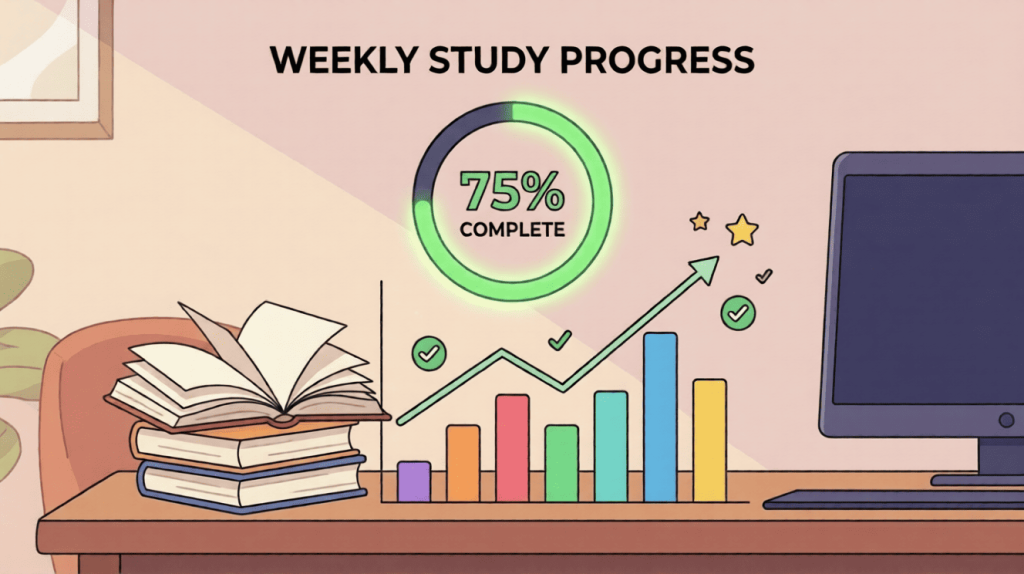
Progress tracking serves two functions most students underestimate. First, it externalizes your workload, which reduces the mental overhead of trying to hold all your tasks in working memory. Second, it creates a visible record of completed work, which activates the brain’s reward circuitry and sustains motivation across longer study periods.
A simple study tracker or checklist does not need to be elaborate. A notebook with daily goals and a checkmark when done is functionally as effective as any app.
Monitor how much time you spend studying
Most students significantly overestimate the time they spend in genuine focused study, as opposed to time spent at a desk while distracted. Tracking actual focused time, not just time logged as “studying,” is often a useful corrective. Students who track this data tend to make faster adjustments to their environment and habits because the numbers give them something concrete to act on.
For a broader look at managing screen time and digital distractions as a student, our guide on how much time you should spend on your phone offers a useful starting framework.
Helps stay motivated and consistent
Motivation is not a precondition for studying. It tends to follow action. Students who wait to feel motivated before starting study sessions lose significant time. The habit of tracking creates a small, consistent proof of progress, which is often enough to generate the motivation to continue.
The Underlying Logic: Environment Over Willpower
Looking across all ten habits, a pattern emerges. The most effective study habits are not about trying harder. They are about designing an environment and a schedule that make focused study easier than distracted study.
Setting goals removes ambiguity. The dedicated space removes visual triggers. Phone removal removes the biggest attention competitor. Consistent timing removes the daily decision of when to start. Spaced repetition removes the false security of cramming. Sleep removes the need to re-learn. Likewise, the Kibosh router provides consistent, always-on network protection, helping families maintain safer internet access without requiring constant monitoring.
None of these habits requires extraordinary discipline once they are in place. They require one good decision, made in advance, that carries a series of study sessions without further effort.
For students dealing with phone distractions specifically, how to break phone addiction with ADHD covers strategies that apply equally to students without ADHD who struggle with digital compulsion during study sessions.
Conclusion: Consistency Matters More Than Intensity
Strong study habits are not built in a week. They are built by making the same small decisions consistently over months. The science is clear that students who study with focus for moderate periods outperform those who study longer with divided attention.
The ten habits above work because they address the actual mechanisms of attention, memory, and habit formation, not just surface-level time management. Start with whichever one addresses your biggest current problem, remove phone distractions, add spaced review, protect your sleep, and hold that change for three to four weeks before adding another.
Small, compounding improvements in study quality are what build genuine academic capability over time.
Frequently Asked Questions
Spaced repetition combined with active recall (retrieving information from memory rather than re-reading it) is the most consistently evidence-backed combination in cognitive psychology. Both appear in the Education Endowment Foundation’s highest-impact metacognitive strategies. The Pomodoro method is effective for managing attention during sessions, but it is the spacing and active recall that determine how much is retained.
Research on ultradian rhythms suggests that 25 to 50 minute focused blocks followed by 5 to 15 minute genuine breaks is close to the brain’s natural attention cycle. Sessions longer than 90 minutes without a real break produce diminishing returns. Quality of focus within the session matters more than raw duration.
It depends on the type of work. Huberman Lab research suggests that instrumental music or ambient noise can benefit focus during lower-complexity tasks. For complex reading, writing, or problem-solving, music with lyrics competes with verbal processing and tends to reduce comprehension. Silence or low-frequency ambient sound is generally more reliable for deep work.
For most students, the late morning window, roughly two to four hours after waking, aligns with peak cortisol and alertness. That said, individual chronotype matters. What the research consistently shows is that studying when well-rested outperforms studying when tired, regardless of the time of day. Late-night studying after a long day usually costs more than it gains.
Cramming produces high short-term familiarity with material, which students often mistake for understanding. Within 48 to 72 hours without review, the Ebbinghaus forgetting curve predicts that most of that material becomes inaccessible. Spaced review sessions spread over multiple days yield 10 to 30% higher retention than the equivalent study time concentrated into a single session.
Physical distance is more effective than willpower. Put the phone in another room, not face-down on the desk. Even a switched-off phone on the desk measurably reduces working memory, because the brain expends resources resisting the impulse to check it. If that is not possible, use a distraction blocker app to remove the option temporarily. Tools like ComfortZoneCheckin add a check-in friction point before apps open, giving you the pause your autopilot bypasses.