

There’s a specific kind of tension that shows up right before you begin something meaningful: task avoidance behavior, the mental sidestep that pulls you toward the refrigerator or your phone the moment a hard project needs starting, the same reflexive pull behind needing a social media break mid-task. This isn’t laziness. It’s resistance, which psychologists often connect with avoidance coping behaviors. It’s common enough that research on procrastination and coping estimates 20-25% of adults worldwide are chronic procrastinators, not occasional delayers, but people for whom this pattern is the default.
The discomfort before starting something important comes from the emotional weight it carries. Hard projects test your ability and carry expectations, often from yourself. Scrolling feels easier than opening the document because scrolling is emotionally neutral, with no risk of failure and no standard to meet. Beginning carries uncertainty, and that uncertainty is what makes it feel heavy.
The Psychology of the First Five Minutes
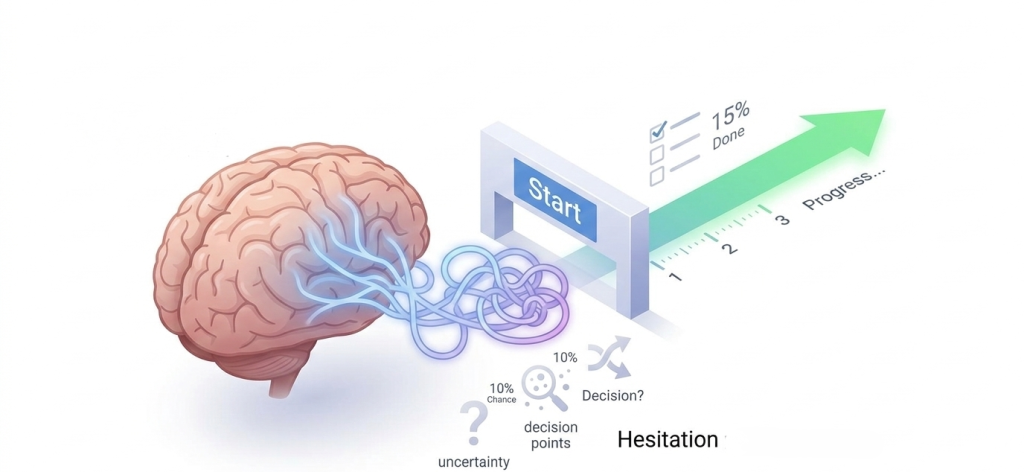
The first five minutes of a hard task are demanding because they combine uncertainty with effort, before your brain can see the outcome clearly. At the same time, your brain is wired toward low-effort, predictable rewards, the same pull behind instant gratification. Meaningful work requires effort before reward: no flow state yet, no visible progress, just effort. That imbalance, high input, low immediate output, is why the first few minutes feel disproportionately hard.
Perfectionism Disguised as Procrastination
Many “hard project” delays come from perfectionism, not poor discipline. You avoid starting because you care, and unhealthy perfectionism can create the anxiety that delays action. As long as the project remains untouched, your potential stays untested. This is different from a bad day or a busy week, it’s the pattern that separates occasional delay from chronic procrastination: the same avoidance, repeated often enough to become the default response to anything hard, not unlike the way bed rotting can start as one lazy afternoon and quietly become a routine.
The Cognitive Cost of Starting
Initiating a hard task takes more mental effort than continuing one, partly because of cognitive overload: your mind is evaluating where to start, how to structure the work, and what tools to use, all before you’ve written a single word. That’s cognitive load in action, a literal overload of working memory, not just an emotional flinch. Once the path is chosen and the task is underway, that constant decision-making drops off. There’s also no visible progress yet at this stage, no feedback loop, no finished paragraph, or even a clear first step for your business plan, which is why the friction is highest and the reward lowest right at the beginning. The discomfort is temporary: once movement starts, even imperfect movement, it begins to shrink.

How to Lower the Barrier to Entry
Overcoming the fear of the first five minutes doesn’t require heroic motivation; it requires a task breakdown strategy that makes the entry point smaller than the resistance itself.
- Step 1: Make the task smaller than the resistance
Set a timer for 5 minutes with one goal: begin, not finish. Five minutes feels manageable in a way “finish the report” never does; the same idea behind picking one of these productive things to do when starting big feels impossible. - Step 2: Use partial tasks instead of whole ones:
Instead of “finish the report,” try “write one rough sentence.” Instead of “design the full presentation,” try “create the title slide.” Partial tasks bypass perfectionism because they don’t demand a polished result, only motion. - Step 3: Remove setup friction in advance
Keep necessary files open, or outline the next step before ending a work session. The fewer decisions you have to make in the moment, the easier initiation becomes.
What Really Happens When You Try to Start
| Stage | What You’re Feeling | What’s Happening in Your Brain | Why It Feels Hard (or Easy) |
|---|---|---|---|
| Before Starting | The brain anticipates uncertainty and effort | Cognitive load stabilizes, and the task becomes concrete | Emotional weight is high, no reward yet |
| First 5 Minutes | Friction, self-doubt, urge to quit | Energy is used to shift into focus mode | High effort, low visible progress |
| 10–20 Minutes In | Increasing clarity and concentration | The brain receives feedback and small rewards | Progress starts reinforcing effort |
| After Momentum Builds | Engagement, flow, reduced anxiety | Cognitive load stabilizes, and the task becomes concrete | Lower resistance, higher satisfaction |
Conclusion: Respect the First Five Minutes
The first five minutes of a hard project deserve respect. They are the point where intention meets resistance, and you don’t need motivation to appear first; you need initiation. Motivation usually follows movement, not the other way around, which is worth remembering next time you’re waiting to feel motivated before starting anything. Once action begins, questions that felt overwhelming become specific, and little progress starts reinforcing itself: each completed piece builds the clarity and confidence to tackle the next one. Sometimes all it takes is a moment to reset your focus and take the smallest possible step forward.
The hardest part is rarely the middle or the end. It’s simply the beginning. Cross that threshold enough times, imperfectly but deliberately, and what once felt intimidating becomes something you know how to face, one small start at a time.