

The average person now checks their phone 186 times a day. That’s roughly once every five to ten minutes you’re awake, according to Reviews.org’s 2026 cell phone usage survey. Read that number again. It’s not a stat about “screen addiction” in the abstract. It’s a stat about how many times an hour something else is competing for the same attention you’re trying to point at a goal.
Here’s the other number worth sitting with: about 80% of New Year’s resolutions are abandoned within the first month. Not because people picked the wrong goal. Not because they didn’t want it enough. Something in between “deciding to do the thing” and “actually doing the thing, day after day” keeps breaking down.
You’ve probably already tried the standard fix. Set a clear goal, write it down, tell a friend so you’re accountable, track your progress in an app. And it worked, for about a week. Then it didn’t. That’s not a willpower problem. It’s a cycle problem, and the cycle is getting interrupted more than most people realize.
Why You Keep Losing Motivation
Motivation isn’t a personality trait some people have more of. It’s closer to a chemical loop: you take an action, your brain releases dopamine, and that dopamine primes you to want to take the action again. Researchers at Kanazawa University published findings in 2026 showing dopamine activity actually rises during the pursuit of a reward, not just when the reward arrives. In plain terms: dopamine is less about pleasure and more about wanting.
That distinction matters more than it sounds. It means the early days of a new goal feel great because the pursuit itself is generating the chemical payoff. You don’t need to finish the marathon to feel a hit of motivation. You just need to be moving toward it. Which is exactly why the feeling fades once the novelty wears off and the pursuit stops feeling new.
There’s an even newer theory worth a quick mention. A 2026 study out of Hebrew University proposes that the brain’s reward system isn’t purely about pleasure at all. It’s about managing energy, essentially deciding where effort is worth spending. If that’s right, it helps explain why motivation dips aren’t a mood problem. They’re closer to your brain recalculating whether an activity is still worth the metabolic cost.
Either way, the mechanism is the same: motivation runs on a cycle, and the cycle needs regular small wins to keep firing. The question isn’t “how do I want this more.” It’s “what’s interrupting the loop before it can build momentum.”
Why the Obvious Fixes Don’t Work
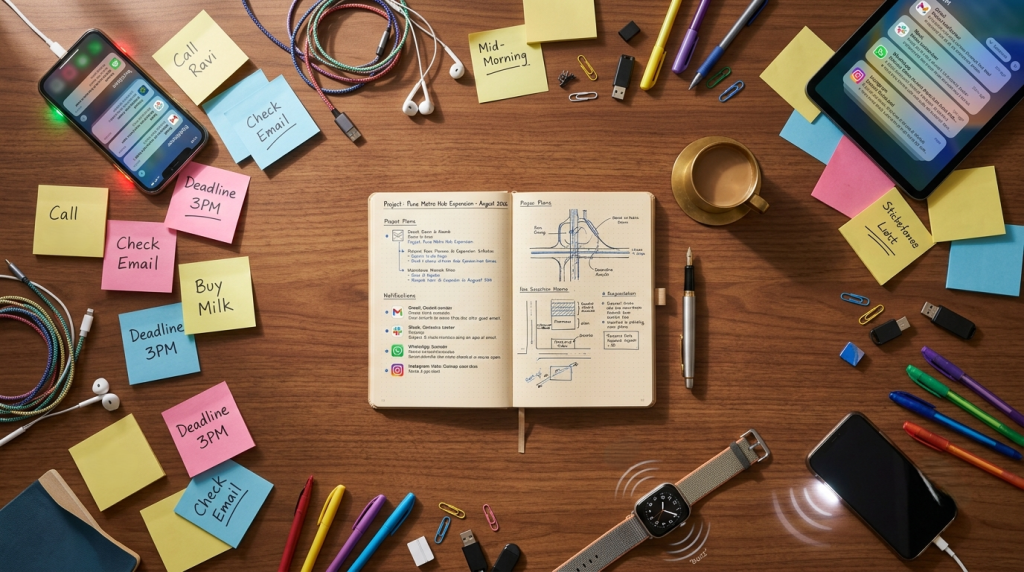
Vision boards. SMART goals. Accountability partners. Every piece of standard advice assumes the problem is clarity, or commitment, or not wanting it badly enough. None of it accounts for the real competition. Your phone delivers a faster, smaller, far more reliable dopamine hit than almost anything else in your day.
The competition costs more than it looks like on the surface. Gloria Mark’s research at UC Irvine found it takes an average of 23 minutes to fully regain deep focus after an interruption. Not 23 seconds. Twenty-three minutes. A single phone check in the middle of a focused work block isn’t a small tax, then. It’s closer to losing the entire session.
And the phone doesn’t even need to be picked up. Just getting a notification, without responding to it at all, measurably hurts your focus on the task in front of you. Your brain still wanders toward it. People who get frequent notifications report higher stress and lower productivity than people who’ve turned them off. That’s the finding from a 2017 study by Kushlev, Proulx, and Dunn.
Here’s the part that’s easy to miss. Interrupted workers often still finish the task. Mark’s research found they sometimes finish just as fast as people who weren’t interrupted at all. It just costs them a lot more in stress and effort. “I still got it done, so it’s fine” is a trap. Sure, the task got done. You just paid for it in a currency you don’t see on the to-do list.
Willpower doesn’t fix this, because willpower isn’t a stable trait you either have or don’t. It’s a resource that gets consumed every time you resist a cue in your environment. Resist the phone once, you’re fine. Resist it fifty times in an afternoon, and eventually the cue wins. Not because you’re weak. Because fighting your environment all day is exhausting, and exhaustion always wins eventually.
We call this pattern the Comfort Loop at ComfortZoneCheckin. A productive stretch quietly tips into passive dwell, and you don’t notice until twenty minutes are gone. If that sounds familiar, our dopamine reset guide goes deeper.
What Actually Works
So try a different reframe. Instead of trying to out-willpower the distraction, change the environment so the distraction takes more effort to reach than the goal-related action does.
Research on habit formation backs this up cleanly. People who are genuinely disciplined don’t have more willpower than anyone else. They’ve just built environments where the tempting option requires extra steps to get to. And roughly 45% of daily behavior runs on autopilot, cued by location and context rather than conscious decision, according to habit researcher Wendy Wood’s work at Duke. Change the location. Change the cue. The behavior often follows without a fight.
Small friction goes a long way here. Something as minor as a 20-second delay, like your phone being in a drawer instead of your pocket, can be enough to break an automatic reach for it. Twenty seconds doesn’t sound like much. It’s often the exact gap between “I’ll just check quickly” and “actually, never mind.”
We call this the Exit Ramp on ComfortZoneCheckin. Instead of relying on your own discipline in the moment, you build a small off-ramp before the distraction can hijack your focus. If app blockers never stuck for you before, this is usually why.
5 Steps to Stay Motivated This Week
None of this requires an overhaul. Start small and let the structure do the work.
- Start With One Small Action
Pick one small, specific action, not the whole goal. Research by Lally and colleagues found it takes an average of 66 days to build a new habit, with a huge range (18 to 254 days depending on the person and the habit). Consistency matters more than speed, and consistency is only possible if the action is small enough to actually repeat.
- Use an Implementation Intention
“When X happens, I will do Y” measurably increases follow-through compared to a vague intention, according to Gollwitzer and Sheeran’s well-known meta-analysis. “I’ll exercise more” rarely survives contact with a busy Tuesday. “When I finish my coffee, I’ll put on my shoes and walk for ten minutes” usually does.
- Add Friction to the Distraction
Add friction between yourself and the distraction during your set window. Phone in another room. Notifications off. One tab open, not twelve. If news is what pulls you in, swap the endless feed for Wow News, which gives you news in 50 words. You already know this. It’s the single highest-leverage change on this whole list, and most people skip it because it feels too simple to matter. More on staying disciplined here.
- Expect (and Plan for) Setbacks
Expect the first attempt to stumble, and plan for it instead of treating a skipped day as proof the goal was wrong. A missed Tuesday means you missed a Tuesday. It doesn’t mean the plan failed.
- Notice the Win Right Away
Notice the moment right after you finish the small action. This is the part almost everyone skips, and it’s the part that actually reinforces the cycle. Not a big reward three weeks from now. The small, immediate acknowledgment that you did the thing, right when you did it. If your habit is fitness-related, make the target measurable, a free TDEE calculator shows the daily energy numbers to aim for, so your streak has something concrete to track.

Common Mistakes and Setbacks
All-or-nothing thinking causes the most damage. Miss one day, and it’s tempting to treat the whole month as a write-off. This thinking is a big reason 80% of resolutions collapse within the first month. One missed day becomes proof of failure instead of just a missed day.
Then there’s relying entirely on willpower with zero change to the environment, then quietly blaming yourself when it doesn’t hold. If the phone is still on the desk, still unlocked, still one glance away, willpower alone was never going to carry the whole load.
And setting a goal too big to fit inside a small daily action trips up almost everyone at some point. “Get in shape” doesn’t fit inside a Tuesday. “Walk for ten minutes after lunch” does. A support network can genuinely help here too, though it’s not the differentiator this article is built around. Having one person who knows what you’re working on rarely hurts. It’s just not a substitute for removing the actual friction point.
Where ComfortZoneCheckin Fits In
If you’ve read this far, you already understand the mechanism: motivation is a reward cycle, and that cycle gets interrupted by small, constant pulls toward something faster and easier. Knowing that is useful. Building the structural off-ramps yourself, every day, without help, is a lot to ask of anyone.
That’s the specific gap ComfortZoneCheckin is built for. Not another willpower pep talk. It notices the Comfort Loop before it starts and adds friction automatically, so you don’t have to remember to do it yourself in the moment. Try ComfortZoneCheckin free.
Conclusion
Staying motivated was never really about wanting something badly enough. It’s about protecting a reward cycle from the dozens of small interruptions competing for the exact same attention your goal needs. Phones aren’t the whole story, but they’re a big, measurable part of it, and they’re the part most advice quietly ignores.
Start smaller than feels necessary. Add friction where the distraction lives. Give the small win a moment to register before you move on. The cycle does the rest.
FAQ
The novelty itself was generating part of the dopamine hit. Once the pursuit stops feeling new, the cycle needs a fresh source of small wins to keep firing, and most goals aren’t structured to provide them.
Yes. Research on habit formation shows most daily behavior is triggered by environment and context, not conscious willpower. Changing the environment tends to outperform trying harder.
Research by Lally and colleagues found an average of 66 days. The range runs from 18 to 254 days depending on the person and the habit. Slower than the popular “21 days” myth, and more forgiving than it sounds.
Yes. Kushlev, Proulx, and Dunn found frequent notifications raise stress and lower productivity, even when you never respond to them. A single interruption can also cost roughly 23 minutes of lost focus to recover from.