Digital habits rarely begin as deliberate decisions. A person may open a social media app for a few minutes, check one notification, switch to another platform, and eventually realize that half an hour has passed. The behavior can repeat several times a day without feeling like a conscious choice.
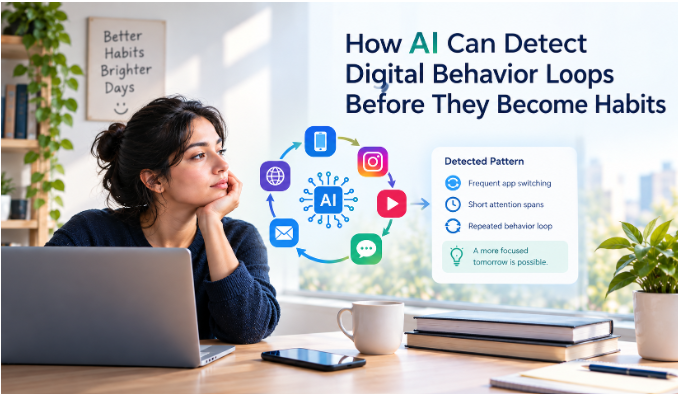
These repetitive patterns can be understood as digital behavior loops. They are not limited to social media. The same pattern can appear when someone repeatedly checks email, refreshes a website, switches between work applications, or searches for information without reaching a clear stopping point.
The challenge is that people often notice the result of a loop rather than the loop itself. This is where artificial intelligence can become useful. By analyzing patterns in digital behavior, AI systems can potentially identify repeated actions and help users become more aware of habits before they become deeply established.
What Is a Digital Behavior Loop?
A digital behavior loop is a repeated sequence of actions triggered by a familiar situation, emotion, or environmental cue.
For example, someone might:
- Encountering a difficult task.
- Feel the urge to take a short break.
- Open a social media platform.
- Scroll through several posts.
- Move to another application.
- Return to the original task.
- Repeat the process when the task becomes uncomfortable again.
The individual actions may appear harmless. The problem develops when the sequence becomes automatic.
Digital loops can also be positive. Opening a calendar before starting work, reviewing a task list, or following a consistent learning routine can become useful patterns. Therefore, detecting a loop does not necessarily mean stopping it. The more important goal is understanding whether a repeated behavior is helping or interfering with what a person intended to accomplish.
Why Digital Loops Are Difficult to Notice
One reason digital loops are difficult to identify is that they are made up of small actions.
Checking a notification takes seconds. Opening another browser tab takes seconds. Looking at one video can take only a few minutes. Individually, these actions may not appear significant.
The pattern becomes more obvious when they are viewed together.
This is particularly relevant to digital wellbeing. Someone might believe that they are simply taking occasional breaks while working, while their actual behavior consists of frequent interruptions that make it harder to return to focused work.
Another problem is familiarity. Repeated behavior eventually requires less conscious decision-making. Once a particular sequence becomes familiar, a person may perform it almost automatically.
How Loop Detection Can Identify Repeated Patterns
Loop detection can look beyond individual actions and examine sequences.
For example, a digital wellbeing application could potentially identify that a user frequently switches between a work application and a distracting application during particular periods. Over time, the system may recognize that the same sequence appears repeatedly.
AI can make this type of analysis more adaptive.
Instead of relying only on fixed rules such as “you have used this application for 30 minutes,” an intelligent system could examine combinations of signals, including:
- Frequency of application switching
- Repeated visits to particular websites
- Time between repeated actions
- Changes in behavior during focused work
- Recurring patterns at particular times
- Repeated interruptions after beginning a task
- Sequences that occur before abandoning an activity
The objective is not simply to count screen time. It is to understand behavior in context.
Where AI Development Services Fit Into Digital Wellbeing
Building a system that recognizes behavioral patterns requires more than adding an AI model to an application. The system needs a way to collect relevant signals, process them, identify meaningful patterns, and present the results without overwhelming the user.
This is where AI development services can support digital wellbeing products.
A development team can build systems that combine behavioral data, machine learning models, analytics, and user-facing interfaces. Depending on the product, AI can be used to identify unusual patterns, classify repeated behaviors, generate personalized insights, or determine when an intervention may be useful.
For example, rather than simply displaying:
“You spent 45 minutes on your phone.”
A more contextual system could identify a recurring pattern such as:
“You frequently switch away from your main task within a few minutes of starting it.”
That difference matters because the second insight provides information about behavior rather than only reporting usage.
How an AI Development Company Can Build Smarter Loop Detection
An AI development company can approach loop detection as a combination of product design, data engineering, artificial intelligence, and behavioral analysis.
The first step is defining what the system is actually trying to detect. A useful product should distinguish between productive repetition and potentially disruptive repetition.
For instance, repeatedly opening a project management application during working hours might indicate productive task management. Repeatedly switching between unrelated applications while trying to complete the same task may indicate distraction.
AI can help identify these differences by looking at patterns instead of isolated events.
A system could be designed around several layers:
Data Collection
The application gathers relevant behavioral signals, subject to appropriate permissions and privacy controls.
Pattern Recognition
Machine learning models or rule-based systems examine repeated sequences and identify patterns that occur frequently.
Context Analysis
The system considers factors such as time, activity, frequency, and sequence rather than treating every action independently.
Personalized Feedback
Instead of presenting a generic warning, the application can provide an observation based on the user’s own recurring patterns.
Continuous Learning
With appropriate privacy safeguards, the system can improve its understanding of which patterns are meaningful for a particular user.
This approach turns loop detection from a simple usage counter into a more contextual digital wellbeing feature.
AI Should Help People Notice Their Behavior, Not Control It
There is an important distinction between detecting a behavior and deciding what someone should do about it.
A digital wellbeing product should not assume that every repeated action is harmful. Someone may intentionally watch videos to relax after work. Another person may need to switch between several applications as part of their job.
For this reason, AI-based loop detection should ideally provide awareness rather than judgment.
The system might highlight a repeated pattern and allow the user to decide whether it is worth changing.
This approach fits naturally with the broader idea of creating healthier relationships with technology. The goal is not necessarily to eliminate digital activity but to make digital behavior more intentional.
Privacy Matters When AI Analyzes Digital Behavior
Behavioral analysis also introduces an important question: how much information should an application collect?
Digital behavior can reveal highly personal information. A system designed to detect loops therefore needs to consider data minimization, transparency, secure storage, permission controls, and responsible handling of behavioral information.
AI development should not treat data collection as an afterthought.
A well-designed system should clearly communicate what information is being analyzed and why. Whenever possible, unnecessary data should not be collected simply because it is technically available.
For digital wellbeing products, trust is part of the product experience.
From Detection to Better Digital Habits
Detection alone does not create change.
Once a recurring loop has been identified, the next step is helping the user understand what triggers it and whether it conflicts with their goals.
For example, a person might discover that their most frequent distraction loop occurs whenever they begin a difficult writing task. That observation could lead them to change how they approach that task, take a planned break, remove unnecessary notifications, or create a more focused working environment.
In this sense, AI can act as a mirror for digital behavior.
It can make patterns that are difficult to notice during everyday use more visible. The decision about what to do with that information can remain with the user.
The Role of Triple Minds in AI-Powered Digital Products
Companies building AI-powered applications need to think beyond the AI model itself. The quality of the final product depends on how data, interfaces, workflows, personalization, and user needs work together.
Triple Minds approaches AI product development with this broader perspective. Its work in AI development can be relevant to products that require intelligent features, personalized experiences, automation, and data-driven functionality.
For a digital wellbeing product, that could mean designing an application where AI is used for meaningful behavioral insights rather than simply adding an AI chatbot because it is technically possible.
The same principle applies across many AI products: the technology should solve a clearly defined user problem.
Can AI Actually Help Break Digital Loops?
AI cannot automatically solve every behavioral problem, and detecting a pattern does not guarantee that a person will change it.
What AI can do is make certain patterns easier to see.
A person may not remember every time they switched applications during a work session. An intelligent system can potentially identify recurring sequences and present them in a way that supports reflection.
That creates an opportunity for digital wellbeing technology to move beyond basic screen-time measurements.
Instead of asking only:
“How long did I use my device?”
future tools may increasingly ask:
“What was I repeatedly doing, and was that behavior helping me accomplish what I intended?”
That shift could make digital wellbeing tools more useful because it focuses on the quality and context of digital behavior rather than screen time alone.
Conclusion
Digital behavior loops often develop quietly. A few seconds of checking, scrolling, switching, or refreshing can eventually become a repeated pattern that is difficult to recognize at the moment.
AI-powered loop detection offers one possible way to make these patterns more visible. By analyzing sequences and context, intelligent systems can help users understand how they interact with technology and identify behaviors that may be interfering with their goals.
For developers and businesses, the opportunity is not simply to build another AI-powered application. It is to create technology that helps people use technology more intentionally.
That is where thoughtful AI development services, responsible product design, and a clear understanding of digital wellbeing can come together. When AI is designed around the user’s actual behavior and needs, it can become less about adding another layer of technology and more about helping people regain control over how they use it.
FAQs
A digital behavior loop is a repeated sequence of actions involving digital devices or platforms. It can be productive or distracting depending on the context and its effect on the user’s goals.
AI can analyze repeated sequences, frequency, timing, application switching, and other behavioral signals to identify patterns that occur regularly.
No. Screen-time tracking primarily measures how long someone uses a device or application. Loop detection focuses more on repeated sequences and patterns of behavior.
AI can potentially identify recurring distraction patterns and provide personalized insights. However, recognizing a pattern does not automatically change behavior; the user still decides what action to take.
Digital behavior can contain sensitive information. AI-powered wellbeing applications should therefore use appropriate privacy, security, transparency, and data-minimization practices.
Yes. An experienced AI development company can combine AI models with application development, data processing, analytics, personalization, and user-interface design to build digital wellbeing products.